Carpet Area, Built-up Area and Super Built-up Area: What Tamil Nadu Flat Buyers Need to Know
When a builder says 1,200 sq ft flat, there is a good chance that is not the area you will actually live in. Here is a plain-language guide to the three area terms every flat buyer in Tamil Nadu needs to understand before signing anything.
Last verified against government sources on . We re-check this post whenever rules change.
In this guide, you'll learn
- Carpet area is the only area term with a legal definition in India. The Real Estate (Regulation and Development) Act 2016, Section 2(k), defines it as the net usable floor area of a flat, including internal partition walls but excluding external walls, service shafts, exclusive balconies or verandahs and open terraces.
- Super built-up area, also called saleable area, is not defined in RERA and is not recognised as standard by India's Bureau of Indian Standards. It includes common areas like lobbies, staircases and lifts. The gap between super built-up area and carpet area is typically 30 to 45 percent in Indian cities, and has been rising.
- Since RERA came fully into force on 1 May 2017, builders of registered projects must disclose and price apartments on carpet area, not super built-up area. Every TNRERA-registered project's carpet area is publicly visible on rera.tn.gov.in.
- When comparing two flats, always compare on carpet area. A flat quoted at Rs. 5,000 per sq ft on super built-up area may cost Rs. 6,500 to 7,000 per sq ft on carpet area once the loading is factored in.
- If the flat delivered to you has a smaller carpet area than what your sale agreement states, you are entitled to a proportionate refund with interest under RERA. If the shortfall exceeds 3 percent, you may also withdraw from the purchase and claim a full refund.
Walk into any builder’s office in Salem and ask about a flat. The salesperson will give you a number: 1,200 sq ft, 1,500 sq ft, 850 sq ft. That number means very little until you know what it is actually measuring.
Three different area terms are in common use in Indian real estate. They are not interchangeable. A flat described as 1,200 sq ft by one builder and 1,000 sq ft by another may be the exact same size, or the 1,200 sq ft flat may genuinely be larger. Without knowing which figure each builder is using, you cannot compare them.
The three terms, in plain words
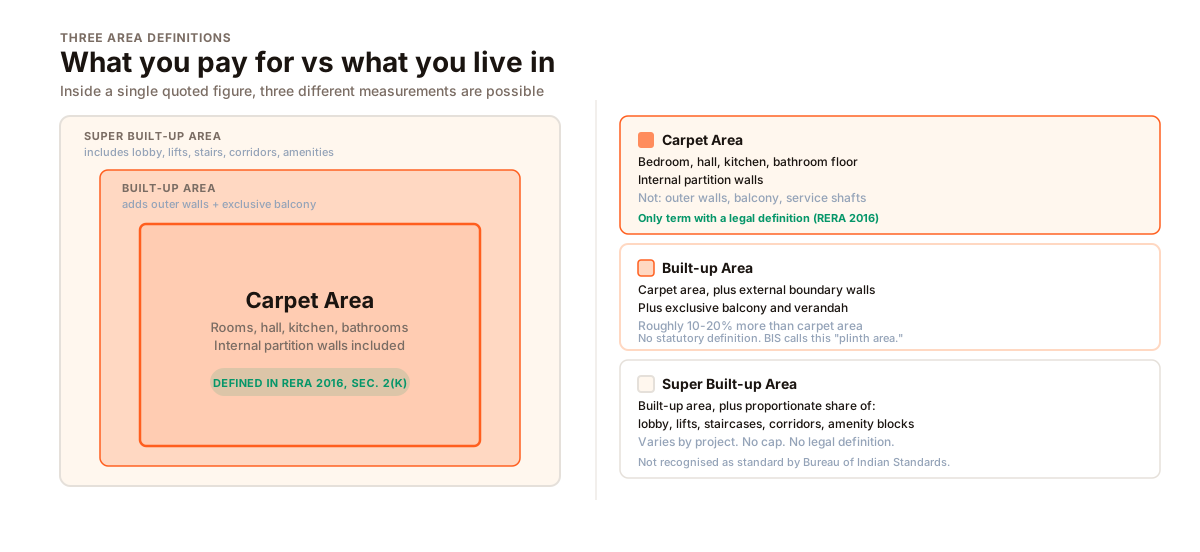
Carpet area is the floor you actually live on. Imagine rolling out a large carpet through your entire flat: across the bedroom, the hall, the kitchen, under the inner walls that divide the rooms. The area that carpet would cover is the carpet area. It excludes the outer boundary walls, the vertical shafts where building pipes run, your exclusive balcony, and any open terrace.
The Real Estate (Regulation and Development) Act, 2016 (RERA) defined carpet area in law for the first time. Section 2(k) says carpet area is “the net usable floor area of an apartment,” including internal partition walls, excluding external walls, service shafts, exclusive balcony or verandah and open terrace.
Built-up area takes carpet area and adds the floor area under the external boundary walls, and usually includes your exclusive balcony and verandah. It is not defined in RERA and has no statutory definition anywhere. India’s Bureau of Indian Standards, the government body that sets national construction measurement standards, defines carpet area and plinth area as two separate measurements in IS 3861:2002. Plinth area is broader, covering all built-up space at floor level including wall thickness; it is closer to what the industry calls built-up area. Crucially, IS 3861 explicitly labels super built-up area as a non-standard term to be avoided. For most apartments, built-up area runs about 10 to 20 percent more than carpet area.
Super built-up area, also called saleable area, takes built-up area and adds your share of the spaces the whole building uses together: the entrance lobby, the stairwells, the lift shafts, the corridors on each floor, the security cabin. Your share is typically calculated by dividing your flat’s carpet area by the total carpet area of the building, so a larger flat carries a larger share. Projects with a gym, pool or clubhouse typically include those too. Super built-up area is entirely an industry convention. RERA does not define it. BIS actively discourages the term. The items included in the calculation vary from project to project.
What RERA changed
Before 2017, there was no statutory definition of carpet area in Indian law. Builders invented their own definitions, applied them inconsistently, and typically advertised on super built-up area because the larger number let them quote a lower per-sq-ft rate. A buyer comparing two projects had no common yardstick.
RERA 2016, fully in force from 1 May 2017, changed this in two ways.
First, it defined carpet area in statute for the first time. Section 2(k) of the Act gives the precise definition, and TNRERA adopts this definition in full. The Tamil Nadu RERA Rules were notified in June 2017 (G.O.Ms.No.112).
Second, it requires builders of TNRERA-registered projects to disclose the carpet area of each flat type when the project is registered with the authority, and to price units on the basis of carpet area, not super built-up. The sale agreement must state the carpet area explicitly, and the price per square foot of carpet area.
Some builders still lead their marketing materials with super built-up figures. That is the advertisement. What matters legally is the figure in the registered sale agreement and the TNRERA project registration. If a brochure shows 1,400 sq ft and the TNRERA registration shows 1,000 sq ft carpet area, the legal number is 1,000 sq ft.
Where the gap comes from
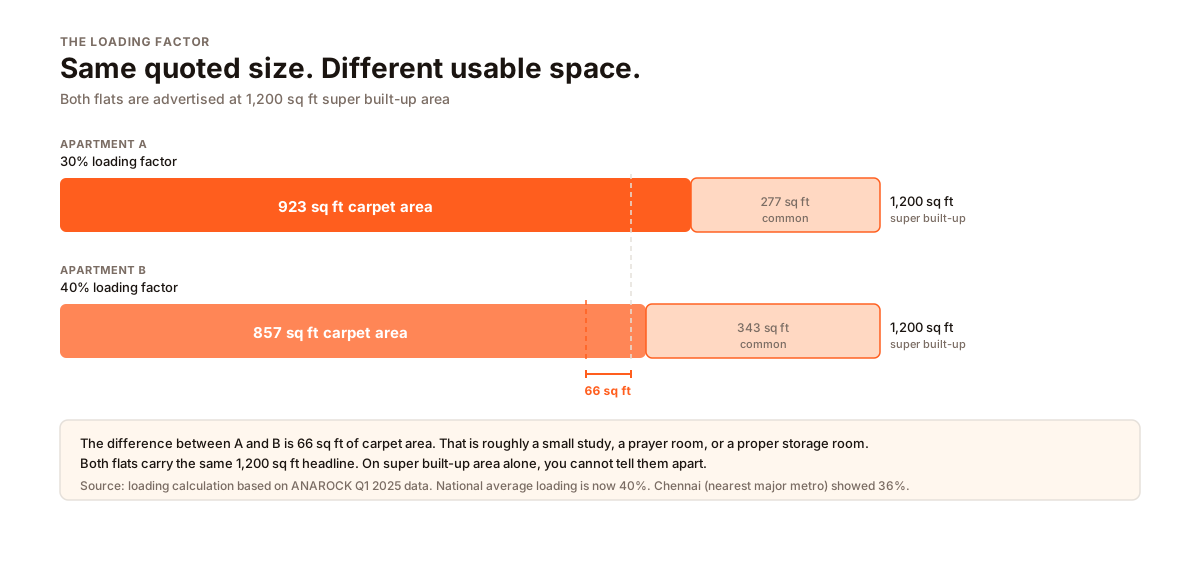
The gap between super built-up area and carpet area is called the loading factor.
Loading factor (%) = (super built-up area minus carpet area) divided by carpet area, multiplied by 100. In plain numbers: a flat with 1,000 sq ft of carpet area that the builder quotes as 1,400 sq ft of super built-up area has a 40 percent loading factor. That means 400 sq ft of the quoted figure is common-area share, not yours to live in.
How large is this gap in practice? Property consultancy ANAROCK’s research for Q1 2025 shows the national average loading across India’s top seven cities is now 40 percent, up from 31 percent in 2019. Chennai showed 36 percent in the same report. In smaller Tamil Nadu cities like Salem, where most projects are mid-rise apartment buildings without large club or pool complexes, loading tends to be lower. No published city-specific data is available, but figures in the 28 to 35 percent range are commonly reported.
There is no regulatory cap on the loading factor. The more amenities a project has, the higher its loading factor tends to be.
Comparing two flats on equal terms
Because super built-up area is not regulated and loading factors vary by project, it cannot be used to compare two apartments side by side. The only fair comparison is on carpet area.
To compare any two flats fairly, start by getting the carpet area of each. For TNRERA-registered projects, this is on rera.tn.gov.in; for others, ask the builder to give it to you in writing, specifying it is the RERA carpet area. Then get the total price for each flat, not just the base price: also include GST, car parking, and any one-time charges for the clubhouse or amenities (many builders show a low base price and add these later, so ask for the all-in figure in writing). Divide the total price by the carpet area. That gives you the price per sq ft of actual usable space. Compare those two numbers, from any two builders. That is the real comparison.
A flat at Rs. 5,000 per sq ft on super built-up area with a 40 percent loading factor is costing you about Rs. 7,000 per sq ft of carpet area. A neighbouring project at Rs. 5,500 per sq ft on super built-up with 30 percent loading costs about Rs. 7,150 per sq ft of carpet area. On the super built-up comparison the first looks cheaper. On carpet area they are almost the same.
What your sale agreement must say
Once you decide to proceed with a purchase, you will sign a document called the Agreement for Sale. This is the binding contract between you and the builder that fixes the flat’s details and price before construction is complete. That agreement must contain:
- The carpet area of the flat, stated separately from the exclusive balcony or verandah area and any open terrace area.
- The price per square foot of carpet area.
- A clause confirming the builder will verify the final measured carpet area after the Occupancy Certificate (the certificate from the local municipality confirming the building is complete and fit to live in) is issued.
RERA caps the permitted variation at 3 percent. For any carpet area shortfall, even one below 3 percent, you are entitled to a proportionate refund of the excess amount paid, with interest. If the shortfall exceeds 3 percent, you may additionally choose to withdraw from the project and receive a full refund.
Read the area section of the agreement carefully before signing. Some agreements state the super built-up area prominently and bury the carpet area in a schedule. Both must be present. The pricing must be on carpet area.
The TNRERA portal: what a buyer can see
No login needed. Any buyer can look up a project’s declared carpet area at rera.tn.gov.in, free of charge.
Every TNRERA-registered building project carries a registration number in its advertisements and brochures, in the format TN/01/Building/XXXX. This number is the key to the portal. If you cannot find it, ask the builder. If they cannot give one, check whether the project requires registration (eight or more units, or land exceeding 500 sq mt).
On rera.tn.gov.in, under Registered Projects and then Buildings, search by registration number, project name, builder name or district. The project page shows the carpet area declared for each flat type, and the exclusive balcony or verandah area separately. This is the builder's own disclosure to the regulator.
If the carpet area on TNRERA and the builder's quoted figure are the same number, good. If the builder's figure is larger, the difference is the loading factor, and you can now calculate the real price per sq ft using the comparison method above. If the TNRERA carpet area is smaller than what the brochure implies as the unit size, ask for a written explanation before paying any advance.
The number that matters
Carpet area is the only number with a legal definition, a statutory basis in RERA, and a mandatory disclosure in every TNRERA-registered project’s sale agreement. Super built-up area is a builder’s marketing convention that became an industry habit. It is not going away, but you do not have to be confused by it.
National average loading has grown to 40 percent (ANAROCK, Q1 2025). Always ask for the carpet area, verify it on TNRERA if the project is registered, and calculate the price per sq ft of carpet area yourself before you compare any two flats.
One practical note for Tamil Nadu buyers: Tamil Nadu’s own building approval rules define carpet area slightly differently from the central RERA Act, differing on whether the floor under your inner room-dividing walls counts. Until this is officially resolved, rely on the carpet area stated in the TNRERA registration and your sale agreement, not on the area figure that may appear on the building plan.
If you are also working through the documents behind a property purchase, our guide to patta, chitta, encumbrance certificate and guideline value explains the four core documents every Tamil Nadu buyer should verify. For the full cost picture beyond the quoted price, our guide on what a Tamil Nadu flat actually costs to buy covers stamp duty, GST and registration fees.
Chola Builders has been building homes in Salem since 1994. If you have questions about a specific flat or project, we are happy to walk you through the numbers in person. Call us or send a WhatsApp message.