The Real Cost of Buying a Flat in Tamil Nadu
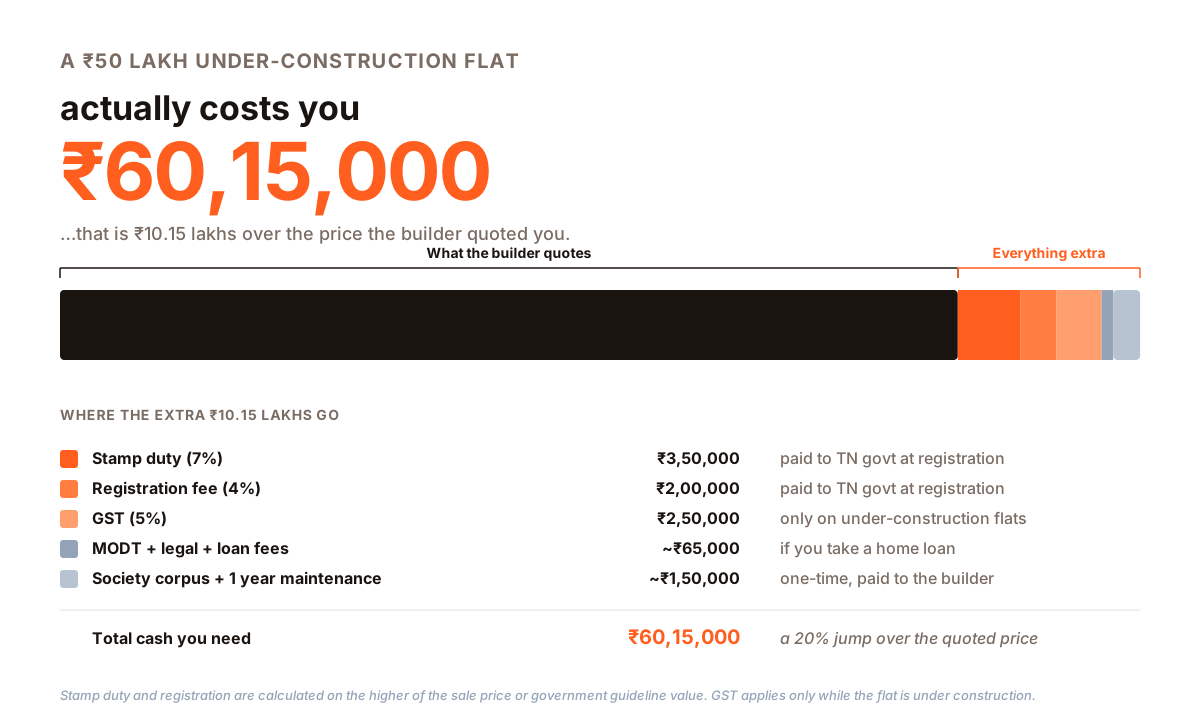
When the builder says ₹50 lakhs, you will actually pay ₹60 lakhs. Here is exactly where the extra ten lakhs goes, with worked examples for ₹30 lakh, ₹60 lakh and ₹1 crore flats.
Last verified against government sources on . We re-check this post whenever rules change.
In this guide, you'll learn
- Tamil Nadu charges 7 percent stamp duty plus 4 percent registration on every flat purchase. That is 11 percent of your flat's value paid to the state on registration day.
- GST adds another 5 percent if the flat is still under construction. Waiting for the occupancy certificate (OC) drops GST to zero.
- Stamp duty is calculated on the higher of your sale price or the government's guideline value (a floor price the state sets for every street), so 'below market' deals don't save you any tax.
- If you take a home loan, the bank-related paperwork (called MODT) costs up to ₹36,000, and legal plus processing fees add another ₹50,000 to ₹1 lakh.
- Budget at least 15 to 20 percent over the quoted price to cover everything. On a ₹50 lakh flat that is ₹10 lakhs of extra cash you will need.
A Salem builder shows you a flat. The brochure says ₹50 lakhs. You like it, you have the funds, you decide to buy. Two months later, when you sit at the sub-registrar’s office to register the sale, the actual money that leaves your bank account is closer to ₹60 lakhs.
This is not a hidden fee. The taxes and charges are all legal, well documented, and applied to every flat sale in Tamil Nadu. The problem is that almost no builder or salesperson walks you through them before you sign. They quote the base price, you budget for the base price, and the extra ten lakhs comes as an unwelcome surprise at the worst possible time.
This guide lays out every rupee you will pay over the quoted price, with worked examples for ₹30 lakh, ₹60 lakh and ₹1 crore flats. Read it before you sign anything. Ten minutes here will save you weeks of scrambling later.
Stamp duty (7%) and registration (4%): the two unavoidable fees
The Tamil Nadu government charges two fees on every flat sale. They are paid together at the sub-registrar’s office on registration day. There are no exceptions, no waivers (with one tiny exception for women buying very small properties, which we will come to).
Stamp duty is 7 percent of the flat’s value. This is a tax on the sale deed itself, paid to the state. On a ₹50 lakh flat, that works out to ₹3,50,000.
Registration fee is 4 percent of the same value. This is the fee for officially registering the sale in government records. On the same ₹50 lakh flat, that is ₹2,00,000.
Together they add up to 11 percent of the flat’s value, or ₹5,50,000 on a ₹50 lakh flat. There is no way to spread this out over months. It has to be in your account on registration day.
How stamp duty is calculated: higher of sale price or guideline value
This is the part many buyers miss until it is too late. Tamil Nadu does not calculate stamp duty on the price you negotiated with the builder. It calculates on the higher of two numbers:
- The actual sale price written in your agreement, or
- The government’s guideline value for that area, a floor price the state sets for every street and survey number.
You can look up the guideline value free on tnreginet.gov.in. It is a way for the government to stop people from registering high-value properties at fake low values to dodge tax.
In practice this means three things. First, suppose you negotiated a great deal at ₹40 lakhs for a flat whose guideline value is ₹50 lakhs. You still pay 11 percent on ₹50 lakhs (₹5,50,000), not on ₹40 lakhs. Second, if the guideline value is ₹40 lakhs and your sale is at ₹50 lakhs, you pay on ₹50 lakhs.
Third, if any builder offers to “show a lower price on paper to save on stamp duty”, refuse. It is illegal, and the sub-registrar will catch it and demand the higher amount anyway.
Before you sign anything, look up your project’s guideline value. It will tell you the floor on what you will pay in government fees.
GST on flats in Tamil Nadu: 5% on under-construction, 0% on ready-to-move
Here is the single biggest variable in your total cost: GST applies only while the flat is under construction. Once the builder receives the occupancy certificate (OC) from the municipal authority, GST drops to zero.
For under-construction flats, GST is 5 percent of the flat’s value. On a ₹50 lakh flat, that means ₹2,50,000.
For affordable housing, GST is just 1 percent. To qualify, two conditions must be met together: the flat must be priced at ₹45 lakh or less, AND the carpet area (the actual usable floor space inside your flat, not counting walls and balconies) must be 90 square metres (about 960 square feet) or less in non-metro cities (which includes Salem, Erode, Coimbatore and every Tamil Nadu city except Chennai). On a ₹40 lakh affordable flat, that 1 percent works out to ₹40,000 in GST instead of ₹2,00,000, a real saving of ₹1.6 lakhs.
There is no Input Tax Credit (any refund of the GST paid) available to flat buyers. Since April 2019, developers also cannot claim ITC on materials they use for residential projects. Both sides lose the credit, which is the trade-off for the lower 5 percent and 1 percent rates. The GST you pay is a final cost.
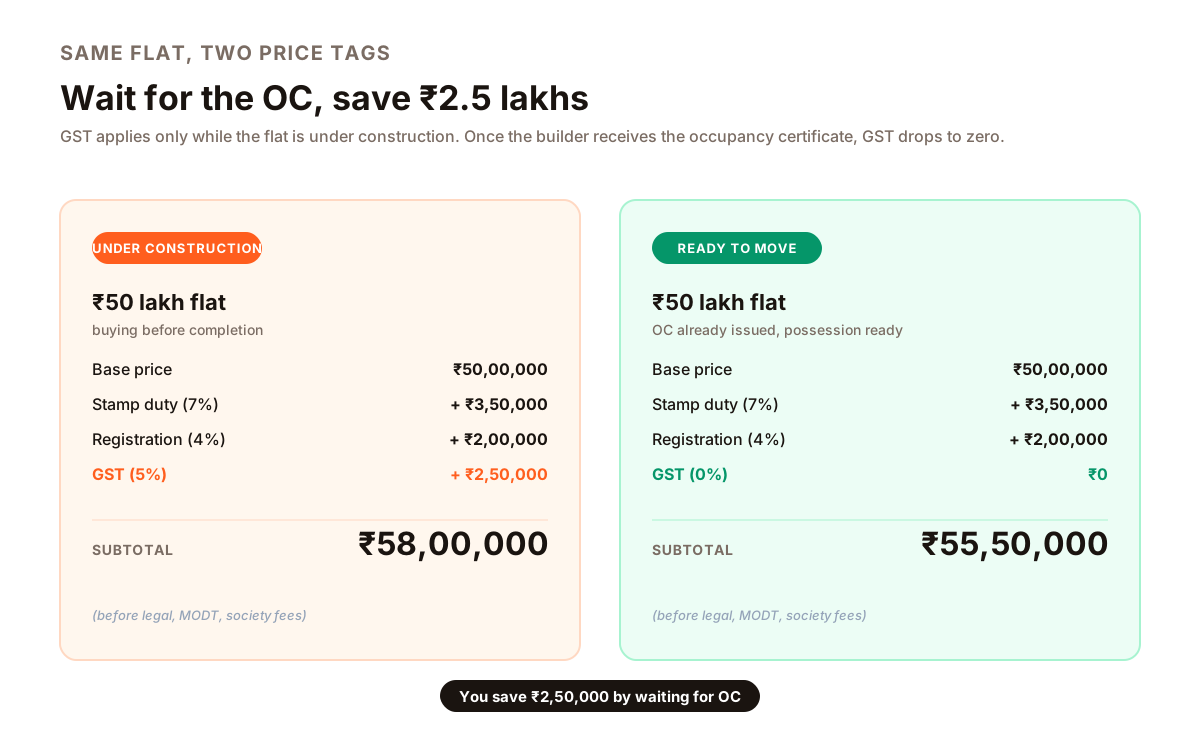
This is not a trick. The GST law itself draws this line. Under-construction property is treated as a “service” the builder is providing to you. Once OC is issued, the flat becomes “immovable property”, which is outside GST entirely. So the trade-off is straightforward: pay 5 percent less by waiting for OC, but you may have to deal with smaller inventory of unsold flats, and you cannot influence customisations on a finished home.
For a Salem buyer with no urgent move-in deadline, waiting for OC on a project that is six to nine months away is almost always worth the 5 percent saving. Ask the builder when OC is expected for the official possession date.
MODT, legal and home loan charges in Tamil Nadu
If you are buying without a home loan (your own funds, paid by cheque or bank transfer), you can skip this section. For everyone else: a home loan brings its own set of fees, and the biggest one catches many buyers off guard.
MODT stands for Memorandum of Deposit of Title Deeds. When you take a home loan, the bank holds your flat’s original title deed as security. The MODT is a separate small registration that records this arrangement at the sub-registrar’s office. It has to be paid on the same day as your main registration.
In Tamil Nadu, MODT is 0.5 percent stamp duty on the loan amount (capped at ₹30,000) plus 1 percent registration fee on the loan amount (capped at ₹6,000). The combined maximum is ₹36,000. For most home loans this will be exactly ₹36,000. It is one-time and non-refundable.
On top of MODT, expect:
- Loan processing fee: 0.5 to 1 percent of the loan amount, often ₹5,000 to ₹40,000 depending on the bank and your loan size.
- Advocate fees for title verification: ₹10,000 to ₹50,000 depending on complexity. For a standard apartment with clean title in a registered project, ₹15,000 to ₹25,000 is typical.
- Document writer fees: ₹5,000 to ₹15,000 to prepare the sale deed itself.
Add it all up and a buyer with a ₹40 lakh home loan should expect ₹50,000 to ₹1,00,000 in loan-related extras on registration day.
Society corpus, club, parking: the builder’s extras (and a pitfall)
After the government and the bank, the third claim on your wallet is the builder, for things beyond the flat itself.
Society corpus (sometimes called sinking fund or one-time deposit) is a one-time amount collected to fund major future repairs: lifts, paint jobs, terrace waterproofing, common-area replacements years down the line. In Salem this typically ranges from ₹50,000 to ₹2,00,000 depending on the project size and amenities. RERA requires the builder to disclose this in writing.
Maintenance advance for the first year is usually due at possession, often ₹2 to ₹6 per square foot per month for 12 months. For a 1,200 square foot flat at ₹3 per square foot, that works out to ₹43,200 paid upfront.
Club or amenity membership in projects with a clubhouse, pool or gym is often charged separately, typically ₹50,000 to ₹3,00,000 depending on the project tier.
And then there is the parking question, which deserves its own paragraph.
The parking pitfall
Open parking and stilt parking cannot legally be sold separately. The Supreme Court ruled in 2010 (Nahalchand Laloochand v. Panchali Co-op Housing Society) that open and stilt parking are common areas of the building, like the lift lobby or the staircase. The builder cannot list them as separate sellable items. Their cost must be included in the flat’s price.
If a builder is charging you ₹2,00,000 to ₹5,00,000 “extra” for an open or stilt parking slot, that charge is illegal. You can refuse to pay it, and if you have already paid, you can file a complaint with TNRERA under Section 31 of the RERA Act. Covered parking inside a closed garage is different: it can be sold separately, but only if it is clearly shown in the approved building plan and your sale agreement.
The women buyer concession (and why it rarely helps)
You may have read somewhere that “women buyers get a stamp duty discount in Tamil Nadu”. The honest answer is: yes, but it is much smaller than it sounds.
From 1 April 2025, the Tamil Nadu government gives a 1 percent reduction on the registration fee (so 3 percent instead of 4 percent) when a property valued at ₹10 lakh or less is registered in the name of one woman, or jointly in the names of two or more women. The catch: any male co-owner on the deed (including a husband as joint owner) disqualifies the deal. And the property value cap of ₹10 lakh excludes almost every urban flat purchase.
For the typical Salem flat at ₹30 lakhs and above, this concession does nothing. It was designed for very small rural and semi-urban property transfers, not for urban apartment buyers. If anyone tells you “register in your wife’s name and save 1 percent stamp duty”, they are confusing Tamil Nadu’s rule with what other states (like Maharashtra) offer. Don’t restructure your purchase based on this assumption.
When each rupee is due
Knowing the total cost is only half the picture. The other half is when you have to have each rupee ready. The worst feeling in a flat purchase is the phone call from the builder or bank, three weeks before registration, asking for ₹6 lakhs you had not set aside. You don’t pay it all on day one, and you should not plan to either.
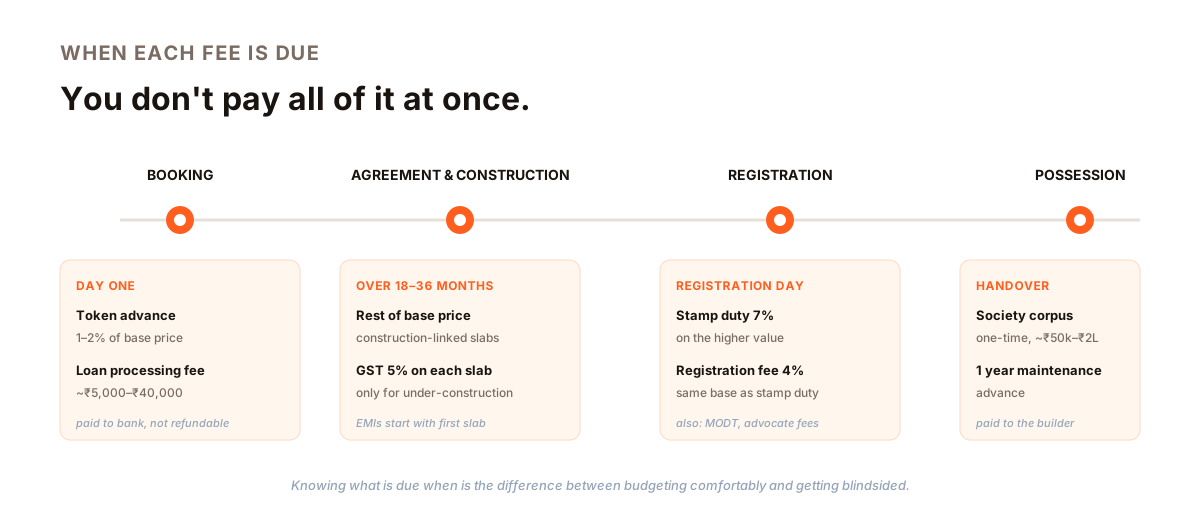
A common mistake is to assume the stamp duty and registration are due at booking. They are not. They are due on registration day, which for an under-construction flat is usually several months into the build, sometimes near the end. By that point you should already have the cash set aside.
The single biggest single-day outflow in your purchase is registration day. For a ₹50 lakh flat with a home loan, expect to take ₹6 to ₹7 lakhs of your own funds to the sub-registrar’s office for stamp duty, registration, MODT and legal fees combined.
Worked examples: ₹30 lakh, ₹60 lakh and ₹1 crore flats
Here is what the math looks like across three common price points for under-construction Salem flats.
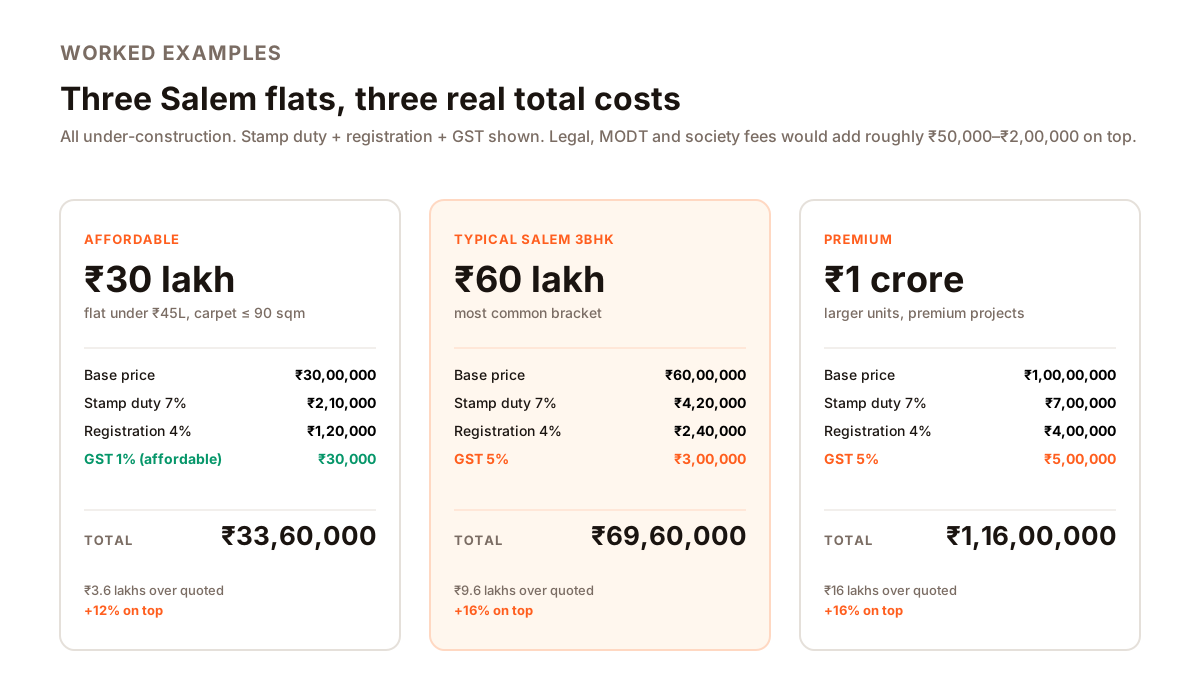
A few things to notice. The ₹30 lakh affordable bracket is the cheapest in percentage terms, because the lower 1 percent GST rate applies. Cross ₹45 lakhs or 90 square metres carpet area, and GST jumps to 5 percent. The total bill jumps with it.
The numbers in the chart cover only government taxes and GST. Add ₹50,000 to ₹2,00,000 for legal, MODT, society and maintenance on top.
The takeaway: budget 15 to 20 percent on top of the quoted price for any under-construction flat in Tamil Nadu above ₹45 lakhs. For affordable housing under ₹45 lakhs, the markup is closer to 12 percent. For a ready-to-move flat where GST does not apply, 12 to 14 percent is the right number.
Can you reduce stamp duty or GST on a Tamil Nadu flat?
Honestly, not much. Here is what works and what doesn’t.
What works: Waiting for OC saves you the 5 percent GST. On a ₹50 lakh flat, that is ₹2.5 lakhs. The single largest legitimate saving available.
What doesn’t work: Registering at a lower price to reduce stamp duty (illegal, and the higher-of rule catches it anyway). The women buyer concession at typical Salem prices (doesn’t qualify above ₹10 lakh). “Negotiating GST out” with the builder (GST is a tax to the central government; the builder collects it and remits it, they cannot waive it).
What is unclear: Some builders include society corpus, parking, and club charges in the headline price; others charge them separately. Always ask for the all-in price including every one-time charge in writing. If a builder hesitates to put it in writing, that itself is the answer.
Before you sign
You will buy a flat once, maybe twice in your life. The builder sells them every week. The tax structure does not change for negotiation, the guideline value does not change for friendly buyers, and GST does not get waived because you are a nice person.
The only protection is to know the numbers in advance. Use the framework in this guide for any flat you are considering. Look up the guideline value. Confirm whether the flat is under construction or has OC. Ask for the all-in price in writing, with every fee broken out separately. Compare against the worked examples here.
If you would like to walk through the numbers for a specific Chola Builders project, call us and we will give you the all-in figure upfront, with every fee broken out. You can also see our current projects or read about our 30-year story in Salem. Every Chola project is registered with TNRERA before sales begin. When you are closer to possession, our flat handover checklist covers the inspection and documents you will need on the day. If you are buying from abroad, our NRI guide walks through the additional rules on bank accounts, repatriation and Power of Attorney.