NRI Guide to Buying a Flat in Tamil Nadu
If you live abroad and want to buy a flat in Salem or anywhere in Tamil Nadu, this is the guide. FEMA rules, NRE/NRO/FCNR accounts, home loans, Power of Attorney, and what happens when you eventually sell.
Last verified against government sources on . We re-check this post whenever rules change.
In this guide, you'll learn
- Under FEMA (the Foreign Exchange Management Act, India's cross-border money rulebook), NRIs and OCIs (Overseas Citizens of India) can freely buy residential and commercial property in India, any number of units, with no RBI approval. They cannot buy agricultural land, plantation property or farmhouses.
- Pay only through banking channels: NRE, NRO, FCNR(B) or direct inward remittance from abroad. Cash is prohibited; the penalty can reach three times the amount under Section 13 of FEMA.
- Where the money comes from at purchase determines how much you can send back abroad when you sell. NRE and FCNR funds are fully repatriable; NRO funds are capped at USD 1 million (about ₹8.3 crore) per financial year.
- Can't fly in for registration? You'll need a Power of Attorney. The process: notarize abroad, apostille or get consular attestation, courier to India, stamp and register at the local Sub-Registrar. Plan 3 to 5 weeks.
- When you sell, the buyer must hold back tax (TDS) under Section 195 of the Income Tax Act: 30% if sold within 2 years; 12.5% without indexation for long-term sales from 23 July 2024 onwards. Apply for a Lower Deduction Certificate before the sale to keep too much from being held back.
If you’re an Indian living in Singapore, Dubai, the US, the UK or anywhere else and you’re thinking about buying a flat in Tamil Nadu, this is the guide. Most NRI buyers we work with aren’t buying for today. They’re buying for parents who live in Salem now, or for a move back home in ten years. The rules look complicated from outside but they’re actually well-defined and consistent. FEMA (the Foreign Exchange Management Act, India’s cross-border money rulebook), the Reserve Bank of India, and the Income Tax Department together cover almost every situation an NRI buyer will run into. The complexity is in the paperwork, not in the rules themselves.
This one’s longer than our other Tamil Nadu buyer guides because the rules have more pieces. Keep 30 minutes aside and read it once; you don’t need to memorise it. It’s also part of our Tamil Nadu buyer series, alongside understanding the real cost of buying a flat and the handover walk-through. NRIs need both of those plus this one.
What you can buy, what you can’t
This is the first thing to confirm because it’s the only place a deal can be illegal regardless of how clean the paperwork looks.
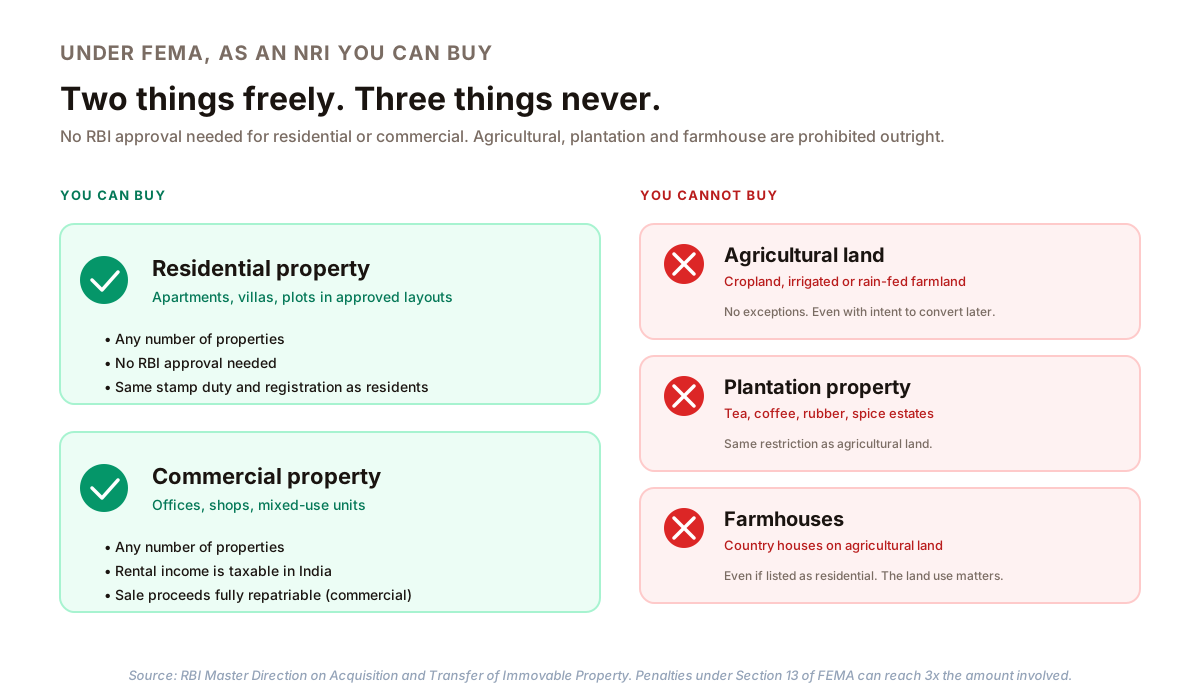
The two-line summary: residential and commercial property in India is open to NRIs and OCIs (Overseas Citizens of India, the lifetime visa status many former Indian citizens hold) without any RBI approval. Apartments, villas, DTCP-approved plots (DTCP is Tamil Nadu’s Directorate of Town and Country Planning, the body that signs off on plot layouts), shops, offices, mixed-use developments. You can buy as many as you like. A few states and Union Territories (Sikkim, Arunachal Pradesh, Nagaland, Mizoram, Meghalaya, and parts of the Andaman & Nicobar Islands) have additional state-specific restrictions on outsider land purchase that can override the general FEMA permission. Tamil Nadu has none.
The forbidden list is short and absolute. Agricultural land, plantation property, and farmhouses. The RBI doesn’t make exceptions, even one-offs; even buying with the stated intent to convert agricultural to residential later is prohibited. The penalty under Section 13 of FEMA is up to three times the amount involved, with an additional ₹5,000 per day for continuing violations. If you receive agricultural land by inheritance, that’s allowed; you just can’t acquire it through purchase.
For a flat in Salem or any other Tamil Nadu city, this is rarely an issue: apartments are clearly residential, DTCP-approved plots are layouts intended for residential construction. The only real watch-out is if a deal involves what looks like a “farmhouse plot” or a layout on a parcel still classified as agricultural in revenue records. Ask for the land’s current revenue classification and the most recent patta certificate (the government-issued ownership and land-use record). If the classification is still agricultural, walk away.
The bank account stack
Where the money for the flat comes from matters for two reasons: FEMA compliance now, and repatriation later (sending the money back to your foreign bank account when you sell).
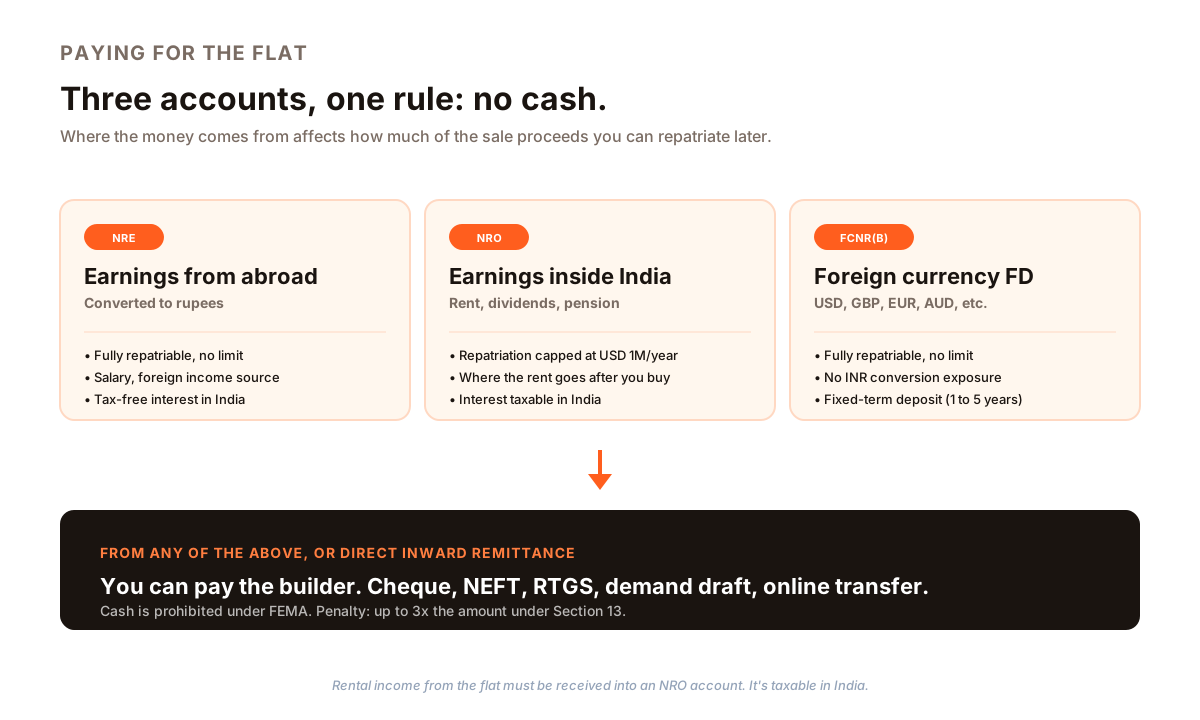
The simple version: open an NRE account for the money you’ll send from your foreign earnings, and an NRO account for any India income (this is also where rent from your flat will land once you buy). The NRE account is fully repatriable, meaning the rupee balance can travel back to your foreign bank account abroad without a cap. The NRO account is capped at USD 1 million (about ₹8.3 crore at current rates) per financial year for repatriation. If you’re going to hold foreign currency in fixed deposits, the FCNR(B) account lets you do that. Pick one or two of these based on how you actually move money.
The most important rule: cash is never an option. Not partial cash and white cash, not “for the parking” or “for the registration”, not “to help the builder with on-paper price”. Cash payments by an NRI for property would be both a FEMA violation (Section 13: up to 3x the amount as penalty) and a Black Money Act 2015 issue. Builders sometimes hint at this; refuse. Pay by NEFT, RTGS, cheque or demand draft from one of your NRI accounts, or via direct inward remittance from your foreign bank.
One subtle but important point: if you fund the purchase from your NRO account (or from money you held before becoming an NRI), the sale proceeds when you eventually sell are subject to the USD 1 million annual repatriation cap. If you fund from NRE or FCNR, the sale proceeds are fully repatriable. For Salem flats at ₹50 lakh to ₹1 crore, the USD 1M cap is rarely binding, but for higher-value purchases the choice of funding account matters.
Getting a home loan as an NRI
Indian banks are open for NRI home loans, and most of the process is remote.
The big four for NRI mortgages are SBI, HDFC, ICICI, and Axis Bank. Loan-to-value is typically 75 to 80 percent for loan amounts above ₹30 lakh; below ₹30 lakh you can sometimes get up to 90 percent. The LTV ceiling depends on where you live. US and UK residents are often capped at 75 percent. GCC-based salaried employees frequently get 80 to 85 percent. Tenure ranges from 20 to 30 years, subject to retirement-age caps (most lenders close out the loan by age 60 to 65).
So on a ₹60 lakh Salem flat, expect a loan offer of ₹45 to ₹48 lakh; you bring the remaining ₹12 to ₹15 lakh as down payment.
What banks will ask for:
- Passport copy
- Work visa or work permit
- Recent salary slips (or business income proof)
- Overseas address proof
- PAN card
- Latest bank statements (Indian and foreign)
- Property documents from the builder
Most banks handle documentation remotely via courier and email; some still require an in-branch or video KYC step.
Two tax advantages of taking a home loan, even when you have the cash:
Section 80C lets you deduct up to ₹1.5 lakh per year on the principal repayment from your Indian taxable income. Section 24(b) lets you deduct up to ₹2 lakh per year on the interest you pay, if the flat is self-occupied. If the flat is rented out, you can deduct the entire interest amount with no cap (the rental income then becomes the offset).
Both deductions are available only if you choose the old tax regime when filing your Indian return; the default new tax regime since FY 2023-24 doesn’t allow them. You’ll need to file an ITR-2 (the income tax return form NRIs use when they have property income). If your Indian rental income is small enough that filing seems like overhead, do the math anyway: ₹3.5 lakh of combined deductions at the 30 percent NRI rate is ₹1.05 lakh of tax saved.
The Power of Attorney process
If you can’t physically be at the registration office in India, you’ll need a Power of Attorney (POA) that lets a representative in India sign on your behalf. There’s no shortcut. Indian law on property registration requires physical signing and verification; electronic POAs are not valid.
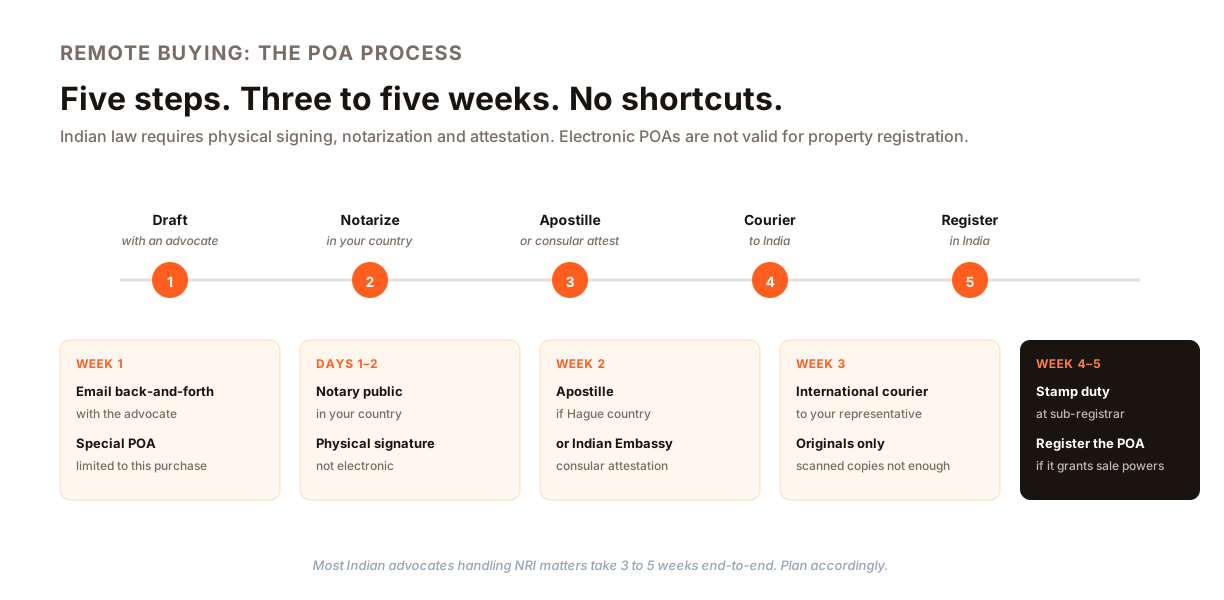
Two practical notes. One: use a Special Power of Attorney, not a General Power of Attorney. A Special POA limits the representative’s authority to one specific purchase, with named property details and a defined scope. A General POA gives broad open-ended authority and is much harder to revoke if your situation changes. Indian sub-registrars also accept Special POAs more readily.
Two: pick the representative carefully. Most NRIs default to a parent, sibling or close cousin in India. That’s usually fine for a single specific transaction. Avoid appointing friends or distant family unless you trust them with the same level of authority you’d give your own bank. A POA that’s been registered is harder to revoke than people realise.
Most NRI property scams start the same way: a too-helpful “family friend” who knows a builder, a builder pushing for cash payment, an unusual urgency to sign before you can verify. If something feels off, hang up and call your bank, your CA, or us. The deal will still be there tomorrow.
If you can fly in for the registration day itself, you can skip the POA entirely. Some NRIs do exactly that: book the flat from abroad, complete most of the paperwork by email, and fly in for the 2 to 3 days that cover registration and handover. For a single flat purchase this is often easier and cheaper than the POA route.
When you eventually sell
This is the most under-prepared phase of NRI property ownership, partly because it’s years away when you buy, and partly because the rules are different (and harsher) than for resident sellers. We’ve written a dedicated NRI selling guide that goes into Section 195 TDS, the Lower Deduction Certificate, capital-gains exemptions (Sections 54, 54F, 54EC) and DTAA in depth. The summary below is the short version.
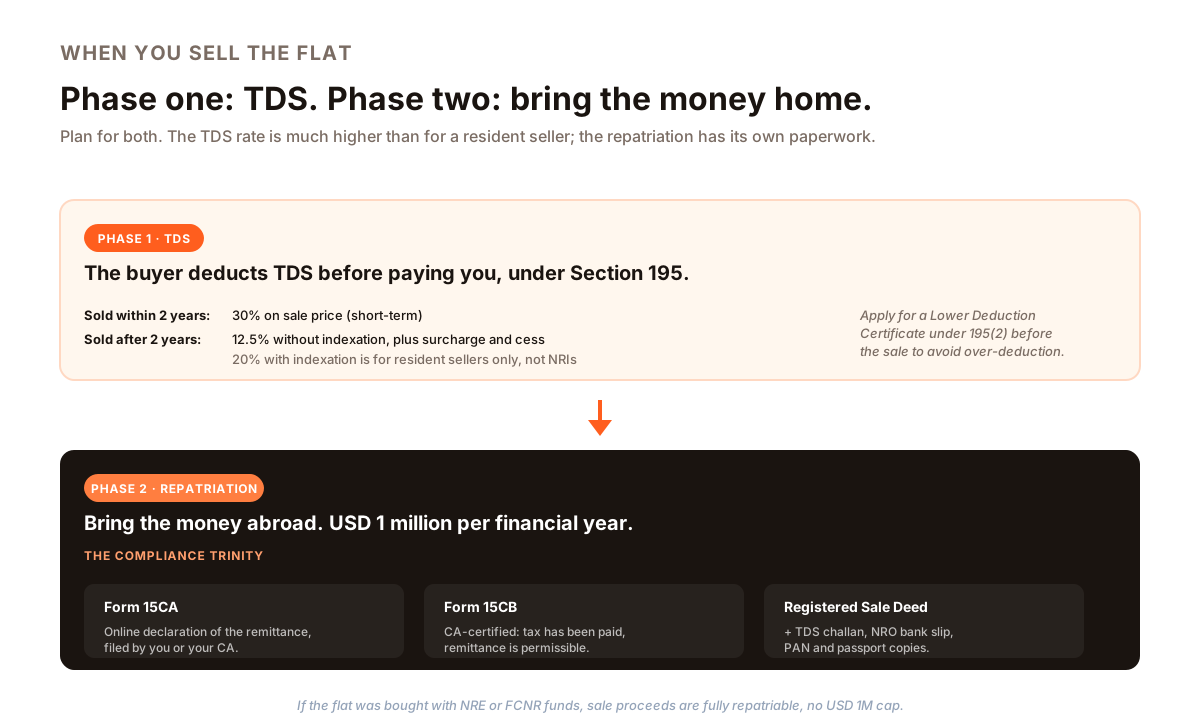
The big difference from a resident sale: when a resident sells property, the buyer deducts only 1 percent TDS under Section 194-IA. When an NRI sells, the buyer must deduct under Section 195, and the rate is much higher.
For a short-term sale (within 2 years of buying), the rate is 30 percent of the sale price. For long-term sales (held more than 2 years) executed on or after 23 July 2024, the rate is 12.5 percent without indexation (indexation is the rule that adjusts your original purchase price upward for inflation; without it, the gain calculation uses the actual purchase price). Plus surcharge and cess.
The Finance Act 2024 amendment that restored the 20%-with-indexation option for older properties was limited to resident sellers; NRIs are not eligible for that route, regardless of when the property was bought. This catches many NRI sellers off guard, including their own chartered accountants.
The catch is that TDS is deducted on the sale price, not on the capital gain. If you bought a flat for ₹40 lakh in 2020 and sell for ₹70 lakh in 2026, your actual capital gain is ₹30 lakh (no indexation for NRIs), and tax at 12.5 percent is ₹3.75 lakh. But TDS at 12.5 percent on the full ₹70 lakh sale price is ₹8.75 lakh, well above your actual liability, held back before you even see the money.
The fix is to apply for a Lower Deduction Certificate under Section 195(2) before the sale. You file with the Income Tax Officer in the jurisdiction where the buyer’s deductor is based, showing your computed capital gain and tax liability. The officer issues a certificate specifying the actual TDS rate that should be applied (often well below the default 12.5 percent of sale price). The buyer deducts at the lower rate, and you get the right amount on day one rather than waiting until next year’s tax return for a refund.
After TDS, the sale proceeds go into your NRO account. From there you send them abroad using three documents: Form 15CA (your online declaration of the remittance), Form 15CB (a chartered accountant’s certificate that taxes have been paid and the remittance is permissible), and the registered Sale Deed plus the TDS challan, NRO bank slip, and copies of PAN and passport. Your bank handles the actual outward remittance once these are in place. Processing usually takes 3 to 10 working days.
The USD 1 million per financial year cap is on aggregate NRO outward remittances, not per property. If you sell multiple properties or have other NRO assets, the limit covers them collectively. If you need to send more than USD 1M in a year, your bank can apply to the RBI on your behalf for special permission. For residential property bought with NRE or FCNR funds, the cap-free repatriation route is restricted to a maximum of two such properties in your lifetime; further residential sales go via the NRO route under the USD 1M cap. Commercial property has no such cap.
A note on Salem specifically
Most of what’s in this post applies to NRIs buying anywhere in India. The reason Salem (and Tamil Nadu more broadly) is worth a separate guide is the diaspora demographic.
Salem has a large Tamil community working in Singapore, Malaysia, the UAE, the US and the UK. Many of them still have family in Salem, and look to Salem as a place to return to one day. The economics are also attractive on their own: a typical 3BHK in good Salem localities (Hasthampatti, Fairlands, Suramangalam, Swarnapuri, Alagapuram) ranges from ₹50 to ₹80 lakh, compared to ₹1.5 crore plus for similar configurations in Chennai or Bangalore. Rental yields are 3 to 5 percent annually, on the higher end for tier-2 India.
The regulatory rules are identical to anywhere else in India. One Tamil-Nadu-specific consideration: for the affordable housing GST rate of 1 percent (versus the standard 5 percent on under-construction flats), Salem qualifies as a non-metro city, so the carpet area cap is 90 square metres (about 960 sq ft) instead of the metro cap of 60. The price cap is the same in metros and non-metros: agreement value must be ₹45 lakh or less. For most NRI buyers looking at 3BHK or larger units, the price cap rules out the 1% rate; for those buying smaller 2BHKs at the ₹40 to ₹45 lakh mark, it’s a real saving.
Before you commit
This guide has covered the regulatory and procedural ground. Companion guides cover the rest of the Tamil Nadu buyer journey, and NRIs should walk through them before signing anything:
- The real cost of buying a flat in Tamil Nadu walks through stamp duty, registration, GST, and the other fees on top of the quoted price.
- The handover checklist is what your representative (or you, if you can fly in) should walk through on registration day.
- If you’re not sure whether you’re an NRI or an OCI (or if you’re still holding a PIO card), our NRI vs OCI vs PIO explainer covers the three diaspora categories, what each can buy, and why PIO cards stopped working at the start of 2026.
If the home is in a 55-plus community, buying and living are two different rules. Can children buy a home in a 55-plus community stays high-level on occupancy. This guide stays on FEMA, accounts, and papers.
If you would like to talk through any of this with someone who has handed over more than a thousand homes in Salem since 1994, call us. We work with NRI buyers regularly, from Singapore, Dubai, Kuala Lumpur, the US and the UK, and can talk through how the rules apply to your specific situation. You can also see our current projects or read about our 30-year story.