
NRI Selling Property in India: TDS, Tax and Repatriation
If you're an NRI selling your Indian flat, the buyer is required to hold back tax (TDS) before paying you. The default rate is much higher than your actual liability. Here is exactly how to fix that, claim every exemption you're entitled to, and bring the money home.
Last verified against government sources on . We re-check this post whenever rules change.
In this guide, you'll learn
- When an NRI sells, the buyer must deduct TDS (tax at source) on the full sale price, not the gain. On a ₹70 lakh sale that often means ₹8 to ₹10 lakhs held back before you see the money.
- A Lower Deduction Certificate (Form 13, filed on the TRACES portal under Section 197) cuts the TDS down to your actual tax liability. Apply 30 to 40 days before the sale.
- Three Income Tax Act exemptions can defer or eliminate capital gains tax: Section 54 (residential to residential), Section 54F (any long-term asset to residential), Section 54EC (capital gain bonds, ₹50 lakh cap).
- Long-term capital gains for NRIs are taxed at 12.5% without indexation for sales from 23 July 2024 onwards. NRIs are not eligible for the 20%-with-indexation grandfathering that resident sellers got.
- If your country of residence has a DTAA with India (most do), you can avoid double taxation. UAE, Singapore, Hong Kong residents pay only the Indian tax. US, UK, Canada and Australia residents get a credit for Indian tax against their home tax.
This is the companion to our NRI guide to buying a flat in Tamil Nadu. At some point, the flat you bought will need to be sold.
Maybe you’ve decided to settle abroad permanently and don’t need a base in India anymore. Maybe the market is right and you’re locking in a gain. Maybe the parents the flat was bought for have passed and the family has decided it’s time to sell.
If you’re reading this because parents have passed, our condolences. The process below is the same, but be kind to yourself on the timeline. You can apply for the Lower Deduction Certificate while the legal heirship paperwork is still being finalised; the two run in parallel. We’ve walked NRI families through this from Singapore and the Gulf many times, and it’s never just a transaction.
This guide covers the tax side, which is where most NRI sellers get blindsided. The default Indian tax-deducted-at-source (TDS) rule deducts way more from your sale price than you actually owe. The only way to fix it is to file paperwork before the sale. The exemptions you can claim are real and legitimate, but they have specific reinvestment windows. And the DTAA (Double Tax Avoidance Agreement) between India and your country of residence is the only thing that keeps you from being taxed twice on the same gain.
The TDS shock, and how to fix it
Start with this: when an NRI sells property, the buyer must deduct tax at source under Section 195 of the Income Tax Act. Not 1 percent like a resident-to-resident sale. The full long-term capital gains rate of 12.5 percent without indexation (indexation means adjusting your original purchase price upward for inflation; the new rule strips that benefit) for sales from 23 July 2024 onwards, or 30 percent if held less than 2 years. And critically, the buyer deducts it on the sale price, not on the actual capital gain.
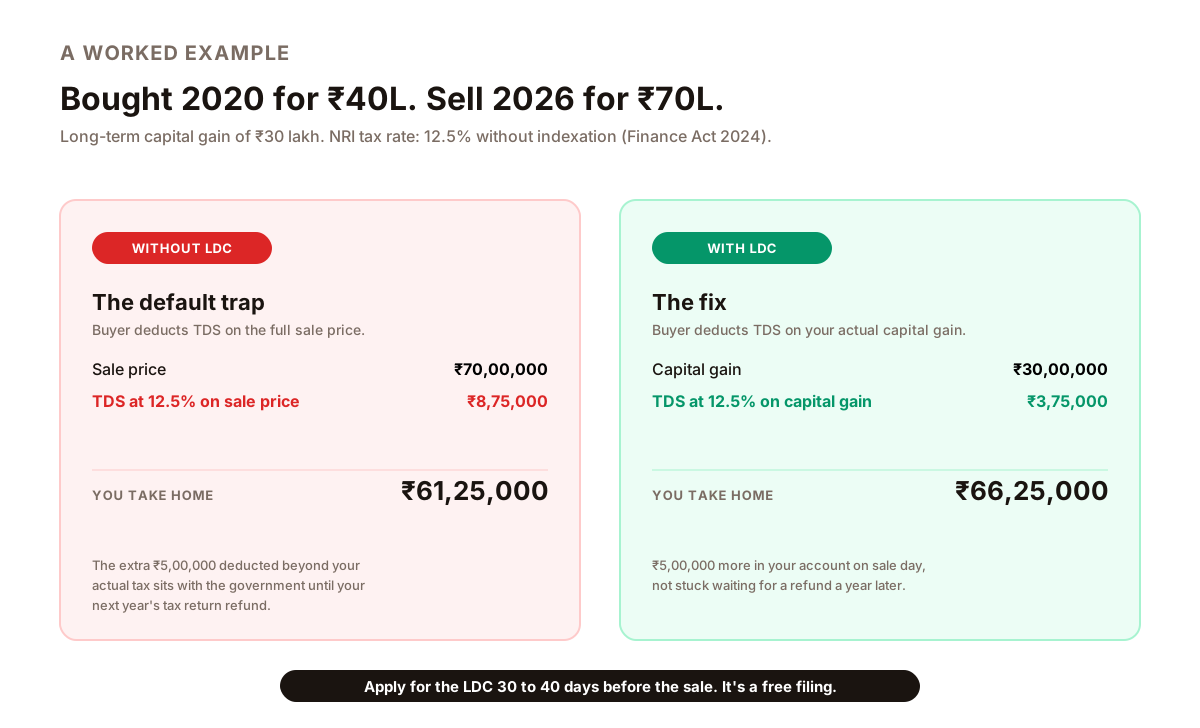
The fix is the Lower Deduction Certificate (LDC). It’s an order from the Income Tax Department under Section 197 that tells the buyer to deduct TDS at a lower rate, based on your actual computed capital gain instead of the full sale price.
You apply by filing Form 13 online on the TRACES portal. You’ll attach your original purchase deed, the proposed sale agreement, a computation of expected capital gain (with help from a CA), your PAN, and bank details for the eventual refund channel.
The Jurisdictional Assessing Officer (the income tax officer for your PAN’s jurisdiction) reviews the application, usually with one online hearing through the portal. Processing typically takes 15 to 45 days, so file at least 30 to 40 days before the sale closing. Once issued, the certificate covers that specific buyer and sale only. You can’t transfer it to another transaction.
The LDC isn’t a tax-avoidance device. You still owe the full tax due on the actual capital gain. What it changes is the cash flow. In our example, ₹5,00,000 stays with you on sale day. Without the LDC, that ₹5 lakh sits with the tax department for 8 to 14 months, until you file next year’s return and claim the refund.
How the capital gain is computed for an NRI
The math is straightforward. One quirk matters.
For long-term sales (held more than 2 years), the gain is sale price minus original purchase price minus allowable selling costs (brokerage, advocate fees, stamp duty paid by you if any). The result is taxed at 12.5 percent without indexation under the post-23-July-2024 regime, plus surcharge (a top-up for higher-income sellers) and 4 percent Health and Education cess.
The quirk: the Finance Act 2024 reform created a transition rule for resident sellers. They get a choice: 12.5 percent without indexation, or 20 percent with indexation, for property bought before 23 July 2024. The law specifically excluded NRIs from this grandfathering option. All NRI sales going forward are at flat 12.5 percent without indexation, regardless of when the property was bought.
This catches many NRI sellers and their chartered accountants off guard.
For short-term sales (held 2 years or less), the gain is added to your other Indian income and taxed at slab rates. The buyer deducts TDS at 30 percent on the sale price, and the LDC route is still available if your actual liability is lower.
One anti-undervaluation rule to know. Under Section 50C, if you sell below the stamp duty value (the government’s guideline value for the area), the tax department ignores your actual price. It uses the stamp duty value instead, and computes capital gain on that. There’s a 10 percent tolerance band: if your actual sale price is within 10 percent of the stamp duty value, the tax department accepts your actual price. Sell 15 percent below stamp duty value, and the tax department will gross it back up to stamp duty value for tax purposes. This catches well-meaning sales between family members at “friendly” prices.
Three exemptions that can cut your tax to zero
Indian tax law gives long-term sellers (NRIs included) three ways to eliminate or defer capital gains tax. You don’t have to pick one; in some cases you can combine them.
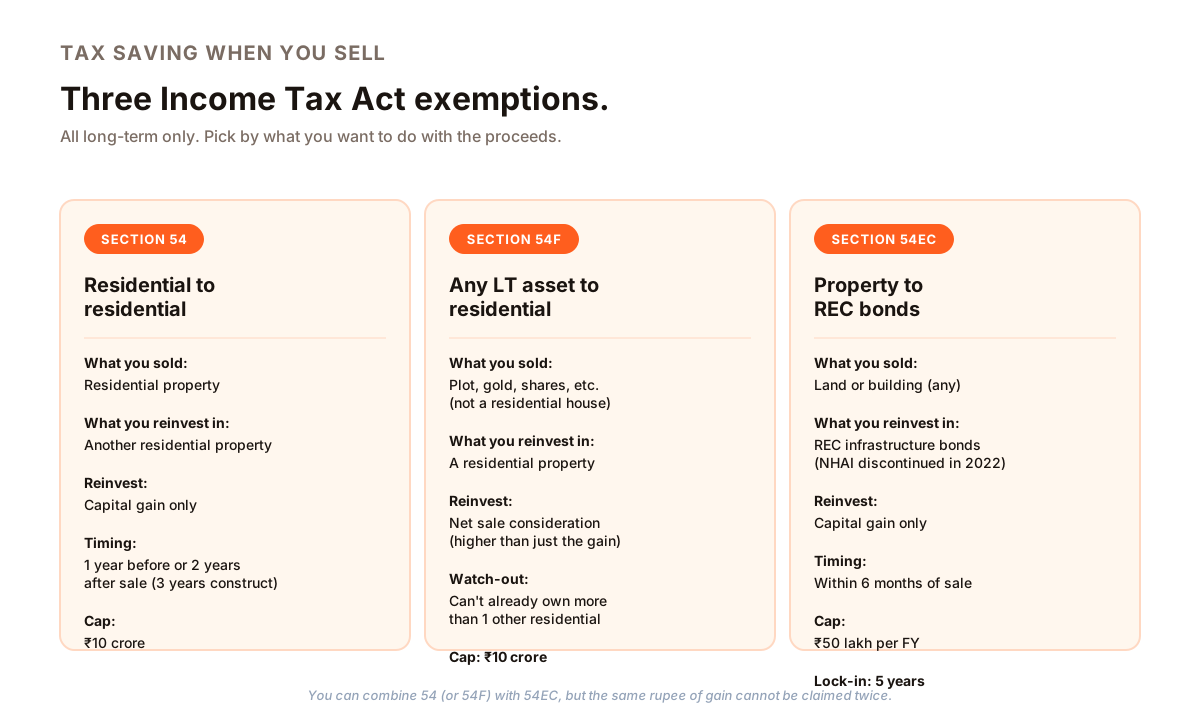
Section 54 is the most common one for NRIs selling a flat. You sold a residential property; you reinvest the capital gain into another residential property within the time windows. Tax on that portion of gain becomes zero. The reinvested property has its own conditions: you can’t sell it within 3 years of purchase (or 3 years of completion if you constructed it), or the tax department reverses the original exemption. There’s a ₹10 crore cap on the exemption (introduced in Budget 2023).
Section 54F is the broader cousin. It applies when you sell any long-term capital asset that isn’t a residential house (a plot of land, gold, mutual fund units, or listed shares, which qualify as long-term assets post-2018). You then reinvest the net sale price (not just the gain) into a residential property. Same time windows, same ₹10 crore cap.
The big catch on 54F: you can’t already own more than one other residential house at the time of sale. You also can’t buy a second new house within 2 years (or construct one within 3 years) of the sale. Break either rule and the tax department reverses the exemption.
Section 54EC is the cleanest if your capital gain is at or below ₹50 lakh and you don’t want to buy another property. Invest the gain into specified capital gain bonds within 6 months of the sale. The eligible issuers as of 2026 are REC (Rural Electrification Corporation), PFC (Power Finance Corporation) and IRFC (Indian Railway Finance Corporation). NHAI (National Highways Authority of India) stopped issuing 54EC bonds in September 2022. Cap is ₹50 lakh per financial year. The bonds have a 5-year lock-in and yield around 5 to 5.5 percent. Section 54EC applies only to gains from selling land or a building, not from selling shares or gold.
You can combine Section 54 (or 54F) with Section 54EC, as long as you don’t claim the same rupee of gain under both. A typical pattern: reinvest most of the gain into a new flat (Section 54), and the residual amount of ≤₹50 lakh into capital gain bonds (Section 54EC). The total covered is then tax-free.
DTAA: not paying tax twice
If you live in a country that has a Double Tax Avoidance Agreement with India, you have legal protection against being taxed twice on the same gain. Most countries qualify; India has signed DTAAs with 90+ countries, covering every major NRI destination.
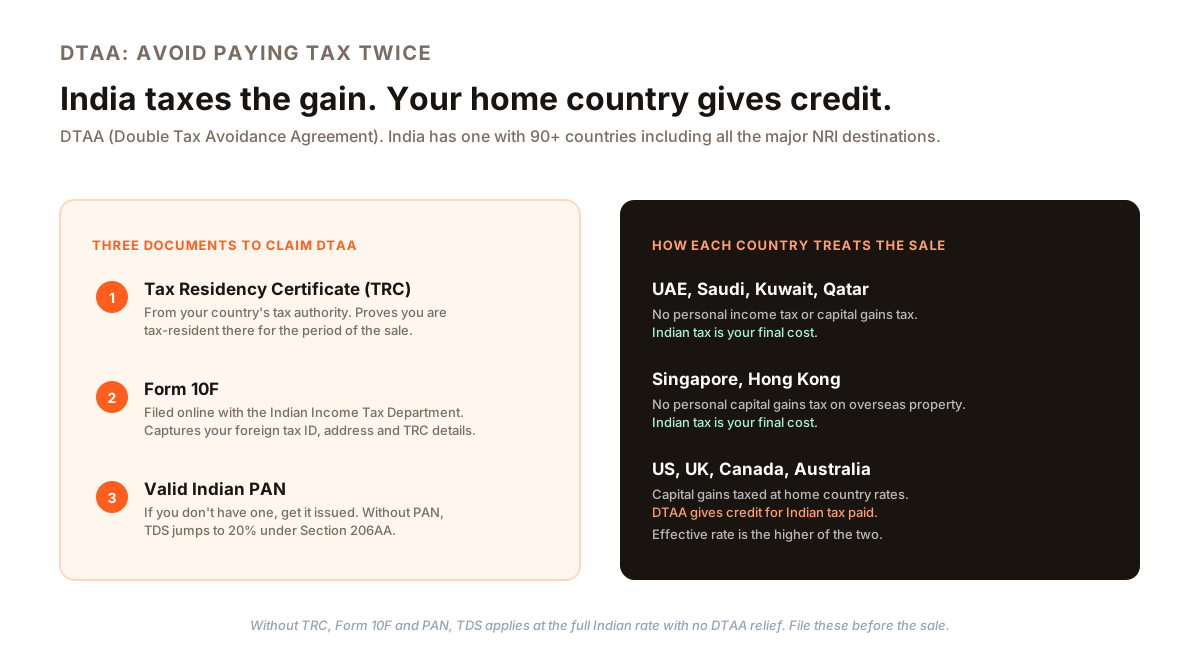
India keeps the right to tax the gain because the property is located in India. Your country of residence does one of two things:
For UAE, Saudi Arabia, Kuwait, Qatar, Singapore, Hong Kong, where personal capital gains tax doesn’t exist on overseas property, the Indian tax you pay is the final cost. There’s no double taxation to worry about because the second country doesn’t tax it. (The UAE’s 2023 corporate tax applies to businesses, not to individual capital gains.)
For the US, UK, Canada, Australia, your home country does tax the gain at its own rates, but the DTAA gives you a foreign tax credit for the Indian tax you’ve already paid. The net effect is that you pay the higher of the Indian and the home country rates, not both. If India’s rate is higher, your home country tax becomes zero. If home country is higher, you pay the difference.
To actually claim DTAA benefit on the Indian side, you need three documents. First, a Tax Residency Certificate (TRC) from your country’s tax authority, usually a one-page document issued on application. Second, Form 10F filed online with the Indian Income Tax Department (mandatory e-filing since July 2022). Third, a valid Indian PAN card.
Without all three, the buyer must deduct TDS at the full Indian rate with no treaty relief, and you’ll be in refund-claim territory after the sale.
One important watch-out on PAN. If you don’t have a PAN at the time of sale, a rule called Section 206AA forces the buyer to deduct TDS at the higher of the normal rate or 20 percent. No exceptions, no DTAA relief. Get your PAN issued well in advance of the sale; the application is free and takes about 2 to 4 weeks for NRI applicants.
The buyer’s compliance load
You’re not the only one with paperwork. The buyer (whether a resident Indian or another NRI) has their own set of obligations under Section 195, and getting it wrong is expensive for them.
The buyer needs a TAN (Tax Account Number, the deductor-side equivalent of a PAN) to deduct TDS under Section 195. From 1 October 2026, resident individuals and HUFs (Hindu Undivided Families, a tax-entity category) will be exempted from the TAN requirement specifically for NRI property purchases, though they will still have to deduct and deposit TDS. Confirm this with the buyer before sale; the timing matters.
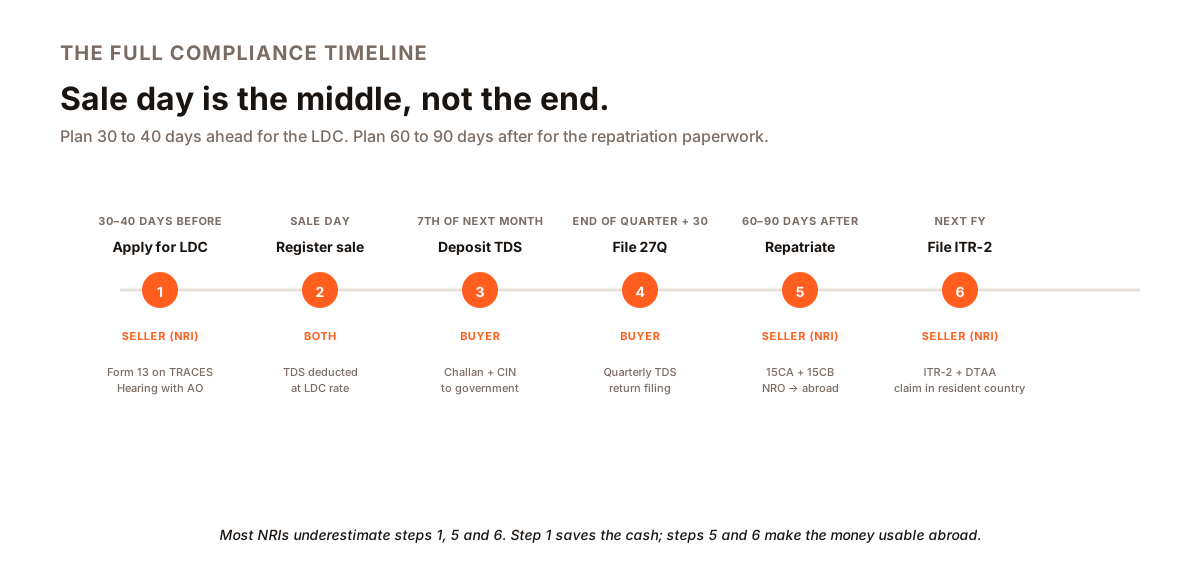
The buyer deducts TDS at the rate on your LDC (or the default rate if no LDC) at the time of payment.
The buyer deposits TDS to the government via challan by the 7th of the month following deduction. So if the sale registers on 12 September, TDS is due by 7 October.
The buyer files a TDS return on Form 27Q (renumbered Form 144 under the Income Tax Act 2025, effective 1 April 2026) within 30 days of the end of each quarter. The quarters end 30 June, 30 September, 31 December and 31 March.
Penalties for non-compliance are heavy.
Under Section 271C, the penalty for not deducting TDS is equal to the TDS amount itself.
Under Section 201, the buyer is treated as ‘assessee in default’ (a tax-department label meaning the unpaid tax can be recovered from them personally). The buyer pays interest at 1 percent per month if they didn’t deduct, 1.5 percent per month if they deducted but didn’t deposit.
Late filing of Form 27Q attracts ₹200 per day under Section 234E.
The professional thing for an NRI seller to do is brief the buyer upfront. Share your LDC, share your CA’s contact, and walk them through the Form 27Q deadline. Resident individuals making their first NRI property purchase often don’t realise the burden until it’s too late. A clean buyer makes for a clean transaction.
The full compliance timeline
Before you sign
Selling Indian property as an NRI rewards preparation. The Lower Deduction Certificate is the single most useful filing because it puts the right tax rate in place at the start rather than at the end. The exemption sections (54, 54F, 54EC) are the second-most useful because they can take the tax bill to zero if you reinvest. And the DTAA documents (TRC, Form 10F, PAN) are the third because they keep your home country from taxing the same gain again.
Get those three things lined up before the sale closes, and the rest of the timeline is just paperwork.
If you’re unsure whether your status is NRI or OCI, or what happens to an inherited flat owned by someone still on a PIO card, our NRI vs OCI vs PIO explainer covers the three categories and the 2026 PIO cut-off.
If you would like to talk through any of this for a Tamil Nadu property, including an inherited flat, call us. We work with NRI buyers and sellers from Singapore, Dubai, Kuala Lumpur, the US and the UK regularly, and can point you to the chartered accountants and advocates in Salem who handle NRI matters well. You can also start at the beginning with our NRI buyer guide, or see our current projects.