Patta, Chitta, EC and Guideline Value: Tamil Nadu Property Documents Explained
Most people who lose money on a Tamil Nadu property purchase do not lose it on the price. They lose it because they trusted the wrong piece of paper. Here is what each of the four core documents actually does, what it cannot do, and how to verify them all online for free.
Last verified against government sources on . We re-check this post whenever rules change.
In this guide, you'll learn
- Patta is a revenue record, not a title deed. Your name on the patta means the government knows you are the person paying tax on the land. It does not, on its own, prove you own it. The Madras High Court has held this repeatedly. The sale deed is what proves ownership.
- Since 2015 the Patta and Chitta are issued as a single combined extract. From 4 March 2026 there is also a new Integrated Land Record (ILR) that combines A-Register, Chitta and FMB sketch into one document, and a Patta History service that shows every ownership change.
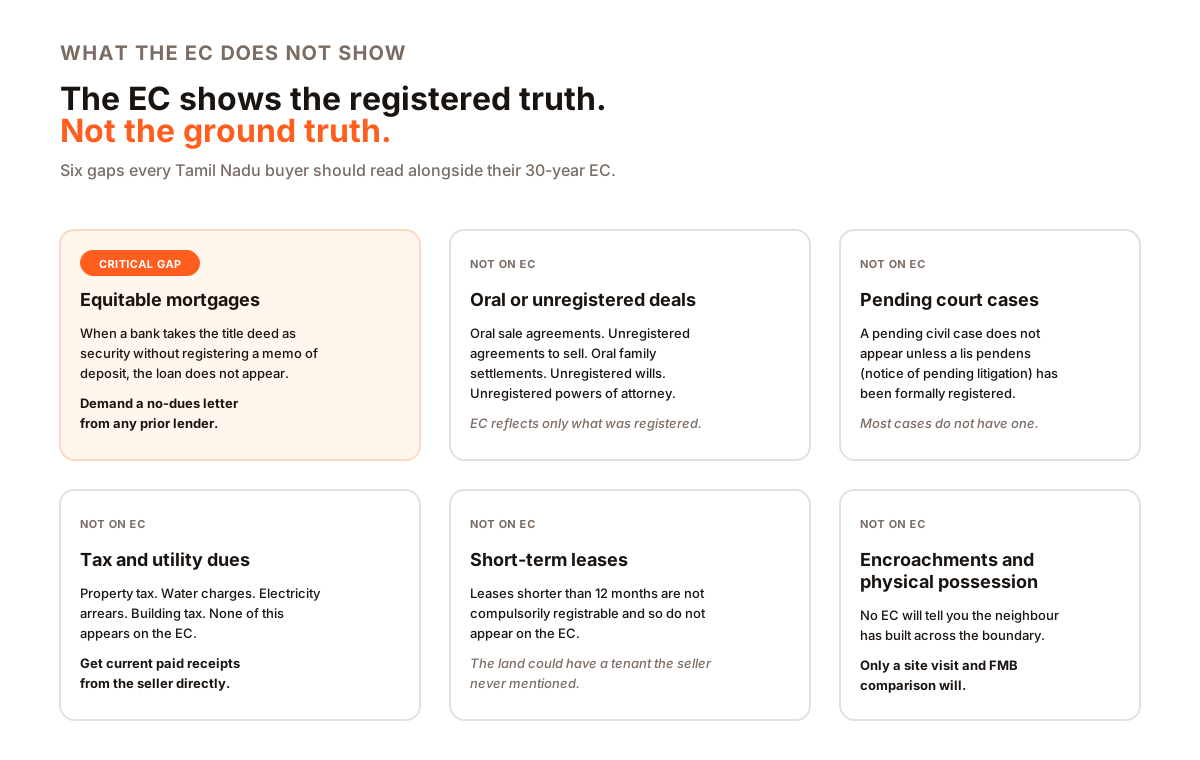
- An Encumbrance Certificate (EC) shows every registered transaction on a property. Form 15 lists encumbrances; Form 16 confirms there are none. But an EC does NOT show unregistered deals, equitable mortgages without a registered memorandum, oral family settlements, tax dues or encroachments.
- Guideline Value is the minimum value at which a property can be registered in Tamil Nadu. Stamp duty is calculated on whichever is higher, the declared price or the guideline value. A buyer cannot register below it. If the gap with the actual price is more than 10 percent, the income tax department can tax the gap on both the buyer and the seller.
- If you are buying an apartment, your name will never appear on a patta. You get an undivided share of the land (UDS) through your sale deed. This is normal, lawful and expected under the Tamil Nadu RERA Rules, 2017.
- Always insist that the sale deed, patta and FMB sketch reference the exact sub-division number (for example 123/2A), not just the parent survey number. Many Tamil Nadu property disputes start with this single line of paperwork being wrong.
Almost every Tamil Nadu property dispute we have seen in 30+ years of building begins the same way. The seller showed a patta. The buyer assumed it meant ownership. The rest of the story plays out in a civil court ten years later, with legal bills that dwarf whatever the buyer thought they were saving.
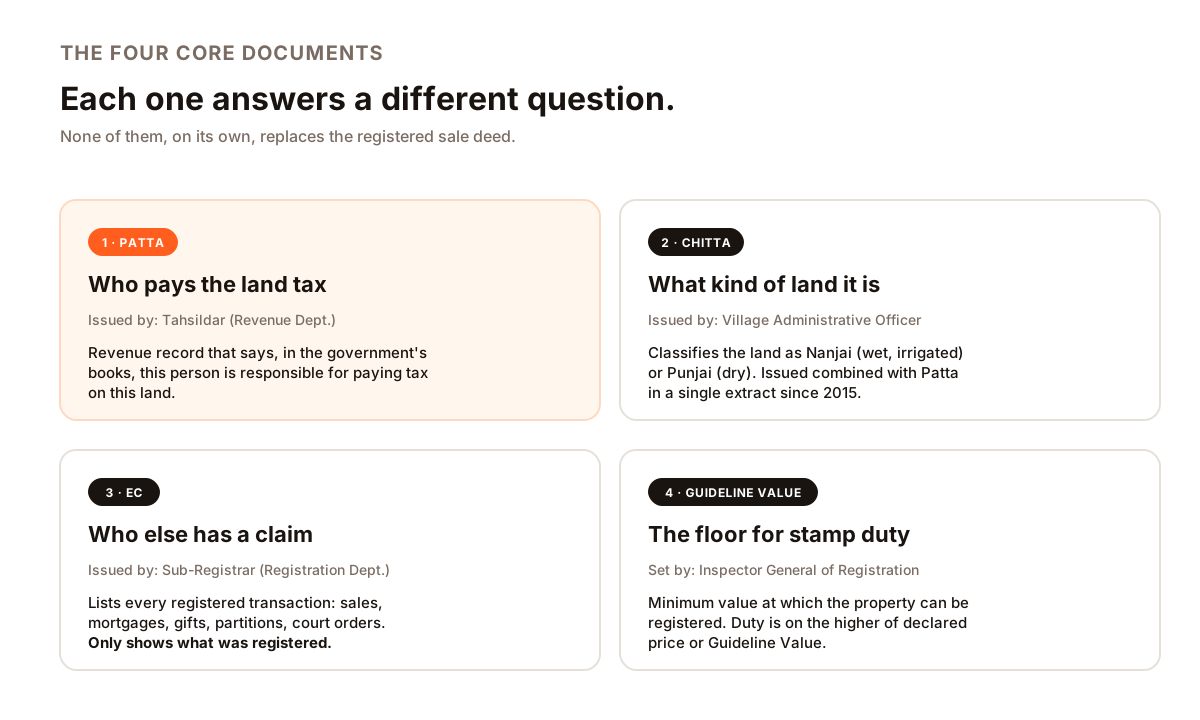
There are four documents at the centre of every legitimate Tamil Nadu property transaction. Patta. Chitta. Encumbrance Certificate. Guideline Value. Each one answers a different question. None of them, on their own, is the same as ownership. Knowing what each document actually proves, and just as importantly what it does not prove, is the single biggest piece of self-protection a Tamil Nadu buyer can do. All four can be checked online, free or for a few hundred rupees, before you pay a single rupee of advance.
This guide is a plain-language tour through what each one is, how to read it, how to verify it, and the specific mistakes Tamil Nadu buyers make with each. It is the explainer we hand to every prospect who asks how to verify a property before they sign.
The four documents, in one picture
Patta: who the government thinks is paying tax on this land
A patta is a revenue record issued by the Tahsildar of the taluk where the land sits. It records, in the state’s accounts, the person who is liable to pay land revenue (called kist) on a particular parcel. The legal backbone is the Tamil Nadu Patta Pass Book Act, 1983 (Act 4 of 1986, which received Presidential assent in January 1986; most provisions were notified into force from 1 April 1993).
This is the single most misunderstood document in Tamil Nadu real estate. Generations of buyers have assumed that a patta in their name proves ownership. It does not. The Supreme Court and the Madras High Court have repeatedly held that patta entries do not create or extinguish title, and have no presumptive value as to ownership. In Smt. Annammal v. Ammavasai (S.A. No. 1505 of 2003), the Madras High Court restated the position: a patta is a revenue record kept for tax collection. It supports a title claim. It does not replace a sale deed.
The rule, in one line
A patta in your name means the government will send the tax demand to you. It does NOT mean you own the land. Ownership flows from the registered sale deed and the chain of parent documents. Patta is corroborative evidence at best.
What a Patta Chitta extract contains
When you pull a patta on the eservices.tn.gov.in portal today, you receive a single combined Patta Chitta extract. In 2015 the Tamil Nadu government merged the historically separate Patta and Chitta documents into one online document, and that is still the case in 2026.
A standard extract carries:
- District, Taluk and Village (in Tamil)
- Patta Number, the reference for this holding in the village register
- Owner name (and father’s or husband’s name)
- Survey Number and Sub-Division Number, for example
123/2A - Extent (area, usually in hectares.ares)
- Land classification from the Chitta side: Nanjai (wet, irrigated) or Punjai (dry, rain-fed)
- Tax (kist) details
- A digitally signed QR code for verification
How to verify a patta in three minutes
- Open eservices.tn.gov.in. It is the official Tamil Nadu Revenue Department portal. No login is required to view.
- Click View Patta & FMB / Chitta / TSLR Extract.
- Choose Rural or Urban depending on where the land sits.
- Pick District, Taluk and Village from the dropdowns.
- Enter either the Patta Number or the Survey Number with Sub-Division.
- Complete the mobile OTP step. The extract downloads as a Tamil PDF.
One small but important warning: the extract is in Unicode Tamil. Do not let your browser auto-translate it. Translation will mangle proper names. If you do not read Tamil, ask a literate friend or family member to read names letter by letter against the seller’s identity documents.
Patta land vs Poramboke land
Not every parcel in Tamil Nadu is private land. Some is poramboke, government land that is not meant for private ownership. The categories include road poramboke, water-body poramboke (ponds, tanks, canals), grazing poramboke, burial-ground poramboke, and Natham poramboke (village habitation common land).
You cannot get a clean title for poramboke. Yet poramboke is regularly sold as private land, sometimes with fabricated or misrepresented documents. Before paying anything for a parcel of land, run the survey number through the Verify Poramboke Land service on the eservices portal. It is free and takes two minutes.
Patta Transfer (mutation): the step most buyers skip
When a property changes hands, the patta needs to be transferred (also called “mutation” or “name change”). The new owner has to apply for this. It does not happen automatically just because the sale deed was registered (although for many clean transactions in 2025-26, it does now trigger automatically through the integrated system).
You can apply for Patta Transfer through the Tamil Nilam Citizen Portal, launched in September 2022, or at any Common Service Centre (CSC). The fee is around 60 rupees at a CSC and roughly 100 rupees online. Timelines vary from a few days for clean automatic mutations to 30 to 45 working days for cases that need a Tahsildar’s review or involve sub-division.
The most common scam in this area is a seller who says, “Patta is in my father’s name, we will transfer after sale.” Do not accept that. Insist that mutation is completed in the seller’s name before registration, or that the cost and risk of doing it is priced into the deal in writing. A patta still in the previous owner’s name means the chain is incomplete and your purchase is exposed.
Apartments: why your name will never appear on a patta
If you are buying a flat in Salem (or anywhere in Tamil Nadu), the patta will not have your name on it. And that is correct. In an apartment building, the entire land parcel sits under one patta in the name of the original landowner or the developer entity. Every flat owner gets a fractional Undivided Share of Land (UDS) stated in their sale deed.
The Tamil Nadu Real Estate (Regulation and Development) Rules, 2017 govern how UDS is conveyed. What you should hold as a flat owner is: the registered sale deed (with your UDS percentage clearly stated), the building approval, the project’s TNRERA (Tamil Nadu Real Estate Regulatory Authority) registration number, and the Occupancy Certificate.
For plotted developments, the patta should ideally be transferred to each plot buyer’s name with a sub-division specific to that plot, after the layout has approval from the Directorate of Town and Country Planning (DTCP), Tamil Nadu’s plot-layout regulator. This is a step where buyers in low-quality layouts often get stuck.
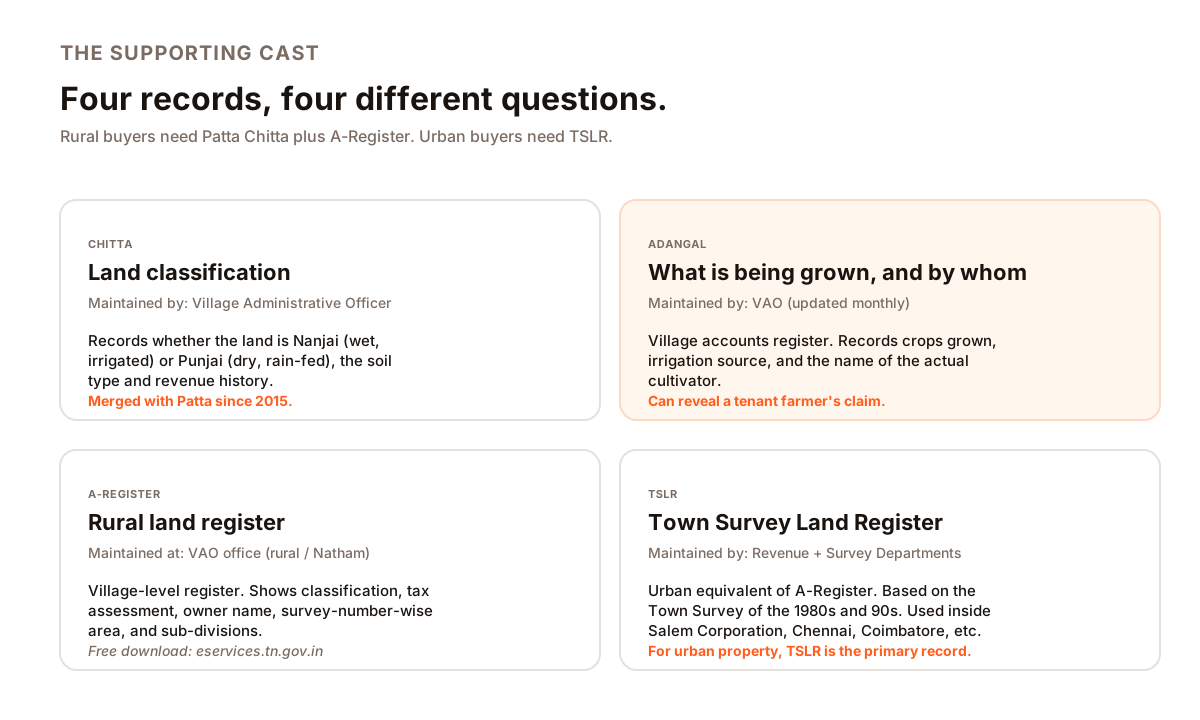
Chitta, Adangal, A-Register, TSLR: the supporting cast
These four are easy to confuse. Each is a different record from a different government department, and each tells you something slightly different about the land.
Punjai vs Nanjai matters more than buyers realise
If you are buying agricultural land or land on the urban edge with conversion potential, the Nanjai or Punjai classification is the most important entry on the Chitta side of the extract.
- Nanjai is wet, irrigated land. Tamil Nadu protects irrigated wetland from conversion to non-agricultural use. You generally cannot convert Nanjai to residential or commercial use.
- Punjai is dry, rain-fed land. It can be converted to non-agricultural use by application to the District Collector, on payment of a conversion charge (commonly cited at around 3 percent of market value, plus a per-plot scrutiny fee; verify locally before relying on these figures).
A common scam: a seller describes a parcel as Punjai with “easy conversion potential”, when the official Chitta says Nanjai. The buyer pays a Punjai price, then discovers the land cannot be developed. Always read the classification from the official extract, not from the seller’s brochure.
The FMB sketch: does the actual land match the paper
The Field Measurement Book (FMB) is the village-level survey sketch showing the physical shape, boundaries and dimensions of every field, with survey and sub-division numbers. It is maintained by the Survey and Land Records Department.
The FMB is what tells you whether the actual fenced or possessed land matches the paper record. Encroachments by a neighbour, missing boundary stones, a wall built three feet inside the field line, all of these will show up only when you compare the FMB sketch against what you can see on the ground.
Pull the FMB at the sub-division level (for example 123/2A), not just the parent survey number. A parent survey number can be five acres while the sub-division being sold is thirty cents. The FMB returned without the sub-division will cover the wrong shape entirely. Then walk the land with the seller and the printed sketch. If the seller resists, that itself is information.
The FMB is free to download from eservices.tn.gov.in.
Sub-division numbers are the precise identifier
Every village is divided into survey-numbered fields. The main survey number identifies the original parcel (123). When the parcel is partitioned by family division or sale, the pieces get sub-division numbers appended (123/1, 123/2, 123/3). Further partition gives 123/2A, 123/2B and so on.
A sale deed that references only the parent survey number without specifying the sub-division (S.No. 123 instead of S.No. 123/2A) is dangerously ambiguous. The extent on the Patta Chitta extract must match the sub-division’s recorded area, not the parent’s total. This is a place where careless paperwork has cost many buyers their entire investment.
Encumbrance Certificate: who else has a claim on this property
The Encumbrance Certificate (EC) is the document issued by the jurisdictional Sub-Registrar’s Office that shows every registered transaction on a specific property over a stated time period. The legal basis is Section 57 of the Registration Act, 1908.
It is the buyer’s single best protection against a fraudulent sale, because it shows whether the seller has actually been the registered owner, whether there is a live mortgage, whether there is a court attachment, and whether the property has been partitioned, gifted or sold to someone else in the recent past.
Form 15 versus Form 16
This is widely confused. The EC comes in two forms, and which one you receive depends on what the register shows for the period you requested.
Form 15 vs Form 16
Form 15 is issued when one or more registered transactions exist for the property during the search period. It lists them in chronological order: document number, registration date, parties, nature of transaction, extent, consideration.
Form 16, also called a Nil Encumbrance Certificate, is issued when there are no registered transactions for the property during the search period.
The difference is whether the register has entries, not how long the period was.
A Form 16 sounds reassuring, but it can also mean you searched the wrong survey number or the wrong period. Always cross-check.
What an EC does NOT show
This is the most under-appreciated point about the EC and the place where careful buyers still get caught.
How to get an EC
The portal is tnreginet.gov.in, the official Inspector General of Registration site for Tamil Nadu. There are two services on it.
1. View EC (free, no login). Search by survey number or document number, see a screen output of the encumbrances. This is for quick reference only. It is not a legally usable certificate.
2. Apply for digitally signed EC. Register on the portal with mobile OTP, search and apply for the certified version. The Sub-Registrar processes it and uploads a digitally signed PDF to your account in 2 to 5 working days. This is the version banks, courts and registration offices accept.
The current fee structure (subject to verification on the portal at the time of application) is roughly:
- Application fee: 1 rupee
- General search, first year: 15 rupees
- Each subsequent year: 5 rupees
- Computerisation fee (for records from 1987 onwards): 100 rupees
So a 30-year EC works out to around 261 rupees in total.
How far back to search
Most property lawyers, and almost every bank lending more than fifty lakhs, ask for a 30-year EC. The 30 years is a long-standing conveyancing convention rather than a single statutory number. Under Article 65 of the Limitation Act, 1963, an owner of private immovable property has 12 years to recover possession against an adverse possessor; a 30-year EC therefore comfortably covers that limitation window, plus older chains of title and most realistic historical claims. (For Government property the comparable period is 30 years, under Article 112.)
A 13-year EC is sometimes accepted by banks for smaller home loans, but it is a banking convention, not a statutory standard. For an outright purchase, get the full 30 years.
Online EC vs the manual certified copy from the Sub-Registrar’s Office
The online digitally signed EC covers records from 1987 onwards in most Sub-Registrar offices. For pre-1987 transactions, or where the local SRO has only partially digitised, you will need to visit the Sub-Registrar’s office in person and request a manual certified copy (CEC). The fee schedule is similar, but it takes 15 to 30 days. For high-value or complex chains, banks and lawyers often still ask for the manual copy because it is the historically authoritative form.
Pre-EC and Post-EC: the two-step every careful buyer does
Get a 30-year EC before signing the sale agreement. Then get a fresh EC 15 to 30 days after your own sale deed is registered. The second one confirms that your sale deed has been correctly entered against the survey number, and that no last-minute encumbrance was registered in the gap between your pre-EC and your registration. It also gives you documentary evidence for patta transfer and any future resale.
This two-step practice is not codified anywhere. It is just what experienced buyers and lawyers do.
Guideline Value: the floor for stamp duty
Guideline Value is the minimum value at which a property can be registered in Tamil Nadu. It is fixed by the state Registration Department under the Inspector General of Registration, street by street in urban areas and survey number by survey number in rural areas. Other states call this Ready Reckoner Rate (Maharashtra), Circle Rate (Delhi, UP) or Guidance Value (Karnataka). The legal basis is Section 47-AA of the Indian Stamp Act, 1899 (as amended for Tamil Nadu), and the procedure is in the Tamil Nadu Stamp (Valuation Committee) Rules, 2010.
How stamp duty is actually calculated
In Tamil Nadu, stamp duty and registration fees are computed on whichever is higher: the sale consideration declared in the deed, or the Guideline Value of the property. You cannot register below Guideline Value to save tax. The Sub-Registrar will compute duty on the Guideline Value instead, or refer the document under Section 47-A for under-valuation.
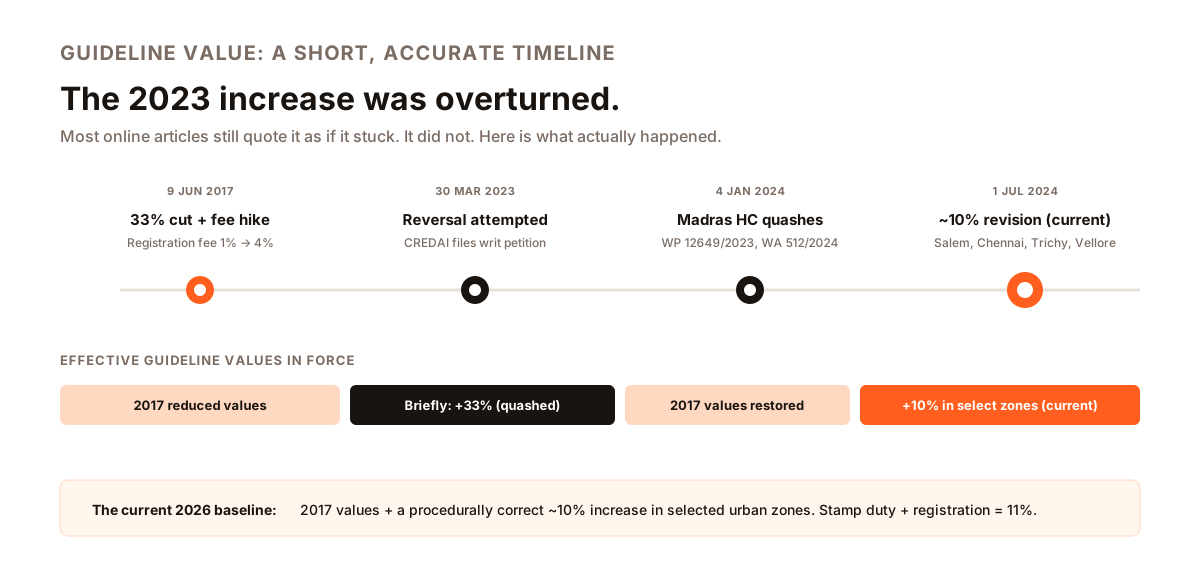
Current standard rates for a sale deed (2026):
- Stamp duty: 7 percent
- Registration fee: 4 percent
- Total: 11 percent of the higher of declared price or Guideline Value
From 1 April 2025, women buyers get a 1 percent concession on the registration fee for properties up to ten lakh rupees, when registered solely in a woman’s name (or jointly only with other women). Joint registration with a husband or any other male buyer is not eligible.
A worked example
Suppose the Guideline Value for a piece of land in Salem works out to 50 lakh rupees. You declare the actual sale price in the deed as 60 lakh rupees.
- Stamp duty base = the higher of the two = 60 lakh
- Stamp duty (7 percent) = 4,20,000
- Registration fee (4 percent) = 2,40,000
- Total cost of registration = 6,60,000
If you had tried to declare only 45 lakh in the deed (below the 50 lakh Guideline Value), the Sub-Registrar would have computed duty on 50 lakh anyway. So the only thing under-declaration achieves is to create tax problems (more on that below).
The 2017 cut, the 2023 reversal, and what stuck
The Tamil Nadu Guideline Value system has gone through three big public events in the last decade, and they explain why current values are what they are.
How to look up Guideline Value
- Open tnreginet.gov.in.
- From the E-Services menu, click Guideline Value Search.
- Choose Search by Street Name or Search by Survey Number.
- Pick Zone, Registration District, Sub-Registrar Office, Village, and (for urban) Street.
- The portal shows the Guideline Value per square foot for urban property, or per acre / cent for rural land.
For flats and apartments, the state moved to a Composite Value system around the end of 2023, with phased expansion through 2024 and 2025. Composite Value combines the land share (UDS) and the building value into a single per-square-foot rate that is then applied to the super built-up area. This closed a long-standing under-valuation loophole where flats were registered with the land value plus a low estimate for construction.
The tax trap if you under-declare
Tamil Nadu’s Guideline Value is enforced by the Sub-Registrar at registration. The Income Tax department enforces a second, sharper rule on top.
- Section 50C of the Income Tax Act (applies to the seller). If the declared sale price is more than 10 percent below Guideline Value, the seller is taxed on capital gains as if they received the higher Guideline Value amount.
- Section 56(2)(x) of the Income Tax Act (applies to the buyer). The same gap, if more than 10 percent and more than 50,000 rupees in absolute terms, is taxed in the buyer’s hands as income from other sources.
So a deliberate under-declaration gets taxed twice, once on each side. The savings on stamp duty are almost always less than the tax cost. Declare the actual price.
New in 2026: the Integrated Land Record
On 4 March 2026, the Tamil Nadu Revenue Minister launched two new statewide services that meaningfully change how buyers can verify a property. They are accessible through the Tamil Nilam Citizen Portal and the eservices.tn.gov.in land records portal.
The first is the Integrated Land Record (ILR). A single digital document that combines the A-Register (record of rights), Chitta (classification and ownership entries) and FMB sketch (field measurement) into one PDF. Previously you had to download these as three separate files. The ILR is the closest thing Tamil Nadu now has to a single consolidated land record extract.
The second is the History of Patta Transfer Report. This displays the entire chain of patta ownership changes for a survey number from 2016 onwards. A buyer can now see every previous patta holder, the date of each transfer, and the Government Order (GO) under which it was authorised. Reported fees are around 50 rupees per year of history plus a 60 rupee processing fee (verify on the portal at the time of application, as fee schedules are still settling). For a clean 10-year history, that works out to roughly 560 rupees, and it can save you from a fraudulent sale by an unrelated party.
If you are buying any non-trivial parcel in Tamil Nadu in 2026, pull both the ILR and the Patta History Report alongside the EC. The information is now there. Use it.
The buyer’s document checklist, in order
- Patta Chitta extract from eservices.tn.gov.in, in the current seller's name. If the patta is in someone else's name, pause and find out why before going further.
- Verify it is not Poramboke land. Run the survey number through the Verify Poramboke service. Free, two minutes.
- A-Register (rural) or TSLR (urban) extract for the property. Confirms the classification, extent and sub-division.
- FMB sketch at the correct sub-division number. Print it and walk the land with the seller. The fence must match the sketch.
- Integrated Land Record (ILR) and Patta History Report from the Tamil Nilam portal. New in 2026; gives you the consolidated record and the full chain of patta transfers.
- 30-year Encumbrance Certificate from tnreginet.gov.in. View free first, then apply for the digitally signed version.
- Guideline Value lookup on tnreginet.gov.in. Calculate your expected stamp duty so the registration cost does not surprise you.
- Parent sale deed and chain of earlier title documents. Take all of this to a property lawyer. The lawyer reads the chain, looks for missing links, and signs off on the title.
- If buying a flat: the project's TNRERA registration, building approval, Occupancy Certificate, and your sale deed with UDS percentage stated. No patta in your name. That is correct.
- After registration: pull a fresh post-EC 15 to 30 days later, and complete your Patta Transfer through Tamil Nilam.
The scams that repeat in Tamil Nadu
A short list of patterns we and other Salem-area builders see again and again. None of them are absolute proof of a problem, but each one is reason to slow down.
The seller produces a patta that is in their father’s or grandfather’s name, with an assurance that “we will transfer after sale”. This is the most common single failure mode. Insist on transfer before registration.
The Chitta classification on the official extract is Nanjai, but the seller’s brochure says Punjai. The land cannot legally be converted. Walk away or get a written commitment from the seller, with a refund clause, that covers the conversion risk.
The seller refuses to walk the land with you and the FMB sketch in hand. There is something on the ground they do not want you to see.
The 30-year EC shows a mortgage in the chain, but no matching release deed. The bank’s lien may still be alive. Insist on a no-dues letter from the bank with the document number of the release deed, before you pay anything.
The seller asks you to declare the price in the sale deed at the Guideline Value, and pay the balance in cash. This used to be normal in Tamil Nadu. It is now a Section 50C and Section 56(2)(x) tax problem for both of you, regardless of any “everyone does it” assurance.
The patta and the sale deed reference different sub-division numbers, or only the parent survey number without a sub-division. Stop and get a property lawyer to reconcile them before going further.
If you are mid-transaction and some of this is making you nervous
If you have read this list and recognised something in your own deal, slow down. Almost every problem here is recoverable before registration. Very few are recoverable after.
The basic standard of due diligence
Every legitimate Tamil Nadu property has a clean Patta Chitta extract, a clean 30-year EC, a sale deed and parent chain that a property lawyer can sign off on, and a registration price at or above Guideline Value. None of those four things, on its own, proves the property is safe. All four together is the basic standard of due diligence.
The whole package costs under a thousand rupees in government fees and a few thousand more for a competent property lawyer. The price of skipping it is sometimes the entire investment.
If you would like to talk through any of this with someone who has been building in Salem since 1994, call us or send a WhatsApp. Happy to walk you through how to verify any property, not just ours. Every Chola Builders project is built on land that has been through this exact verification, with parent documents and clean approvals, and the TNRERA registration number is on every project page and every brochure.
Once you have verified the documents, the next thing to understand is the cost of the purchase itself. Our plain-language breakdown of stamp duty, registration, GST and the other fees walks through what an apartment purchase actually costs in Tamil Nadu, with worked examples. And when the build is complete and it is time to take possession, our flat handover checklist is the inspection to do before you sign anything.