M-Sand and River Sand: What Every Salem Home Buyer Should Know
A few years ago, almost every building in Tamil Nadu was built with river sand. Today, licensed builders mostly use M-sand. Understanding the difference helps you ask the right questions before you buy.
Last verified against government sources on . We re-check this post whenever rules change.
In this guide, you'll learn
- M-sand (manufactured sand) is made by crushing hard granite through a vertical shaft impact (VSI) crusher. The resulting particles are angular and cubical. Quarry dust or crusher dust from a jaw crusher is not the same product and should not be used as a substitute.
- River sand mining has been severely restricted in Tamil Nadu since 2003, and especially after 2017, because large-scale extraction lowered riverbeds and dried up wells across the state. Legal river sand is now booked only through the state portal tnsand.in.
- Tamil Nadu's M-Sand Policy 2023, released in March 2023, made BIS certification mandatory for all M-sand manufacturers in the state. All licensed units must also hold a quality certificate from Tamil Nadu PWD and test their product every six months at a NABL-accredited laboratory.
- There are two grades that matter for a home: M-sand (Zone II under IS 383:2016) for structural concrete in columns, beams and slabs, and P-sand (Zone III, finer) for wall plastering and masonry mortar. Using the wrong grade is the most common M-sand quality complaint.
- Certified M-sand from a proper VSI plant meets the Indian standard for residential concrete and has near-zero clay content. River sand from unregulated sources can carry five to fifteen times the permitted silt, weakening concrete significantly.
- Asking your builder for a batch test certificate from the sand supplier is the simplest quality check you can make. Any reputable supplier provides one, showing sieve analysis and silt content for each delivery.
Run a handful of M-sand between your fingers and you know immediately it is not beach sand. The grains are angular and rough-edged, more like tiny broken stones than the smooth rounded grains most people picture when they think of sand. That rough texture is deliberate, and understanding why it exists, and why it has become the norm at licensed builders across Tamil Nadu, is worth a few minutes of any home buyer’s time.
M-sand (manufactured sand) is now used in most Tamil Nadu buildings under construction. River sand, the smooth natural variety, is available legally on only one day a week through a state government portal, and demand runs at roughly ten times the legal supply. For a Salem home buyer, this shift is not a cause for concern. A builder who can tell you what grade of M-sand they are using and why is giving you exactly the kind of transparency that matters.
What is river sand?
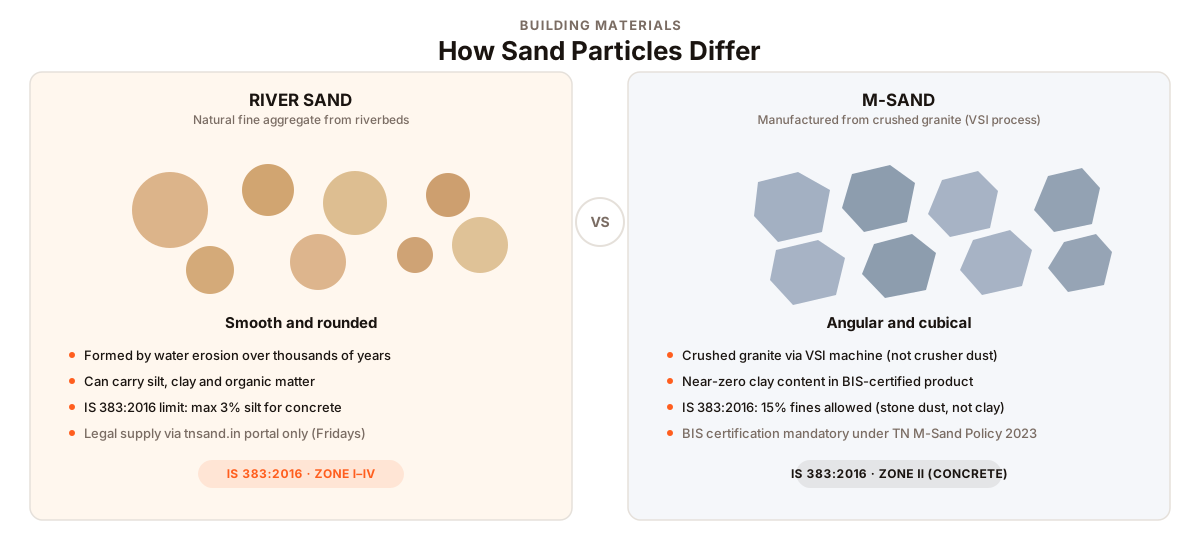
River sand forms naturally over thousands of years. Water carries rocks and minerals downstream, grinding them until the particles become smooth and rounded. The result is fine aggregate (the construction term for sand-sized particles used in concrete) with a warm colour and soft grains that slide past each other easily in a mix.
Tamil Nadu river sand is mostly quartz, with feldspar, mica and magnetite. It also picks up silt, clay and organic matter as it settles on the riverbed. That contamination is the quality risk. IS 383:2016, the Bureau of Indian Standards specification that governs which aggregates can be used in concrete, sets the maximum clay-silt content for natural sand at 3 percent. River sand from unregulated quarries in Tamil Nadu routinely tests at five to fifteen times that limit.
What is M-sand and how is it made?
M-sand is produced by crushing hard rock, typically granite or quartzite, through a three-stage process.
The first two stages, jaw and cone crushers, break quarry rock down to coarse fragments. The third stage uses a vertical shaft impact crusher, or VSI. Inside a VSI, rock pieces are flung outward by a high-speed rotor and collide against a steel ring or against other rock. That impact fractures the particles into angular, roughly cubical shapes rather than the flat or elongated pieces that jaw and cone crushing alone would produce.
The crushed material is then screened to keep the 0 to 4.75 mm size range and washed to remove fine stone dust and any clay.
One important distinction: quarry dust or crusher dust, the screenings left over from primary jaw crushing at a quarry, are not M-sand. IS 383:2016 explicitly states that crusher dust cannot be called crushed sand. It lacks the controlled gradation and particle shape that the standard requires. A builder buying from a BIS (Bureau of Indian Standards) certified supplier has documentation confirming the VSI process was used.
Why river sand became scarce in Tamil Nadu
River sand looked like a free resource for a long time.
Tamil Nadu has 95 rivers with sandy beds. By the mid-2010s, riverbeds in the Thamirabarani basin (Tirunelveli district) and Palar basin (north Tamil Nadu) had dropped by as much as 15 metres, according to state measurements cited by Circle of Blue, a water-issues news organisation, in a 2017 investigation. River sand acts as a natural subsurface filter: it slows rainwater as it percolates into the ground, recharging wells and aquifers. When that layer is removed, the recharge pathway breaks.
By 2014, approximately 18 lakh wells across southern Tamil Nadu had dried up, according to a statement by then-Union Minister E.M. Sudarsana Natchiappan in Parliament. In the Madurai area, the water table fell from around 50 feet to over 600 feet in some parts. Nine shutters of the Mukkombu Upper Anaicut in Tiruchirappalli failed in 2018; critics and environmental groups attributed the damage partly to riverbeds weakened by upstream sand extraction, while the state government cited the structure’s age (built in 1836) as the primary cause.
Tamil Nadu responded over two decades with a series of government orders and court directions:
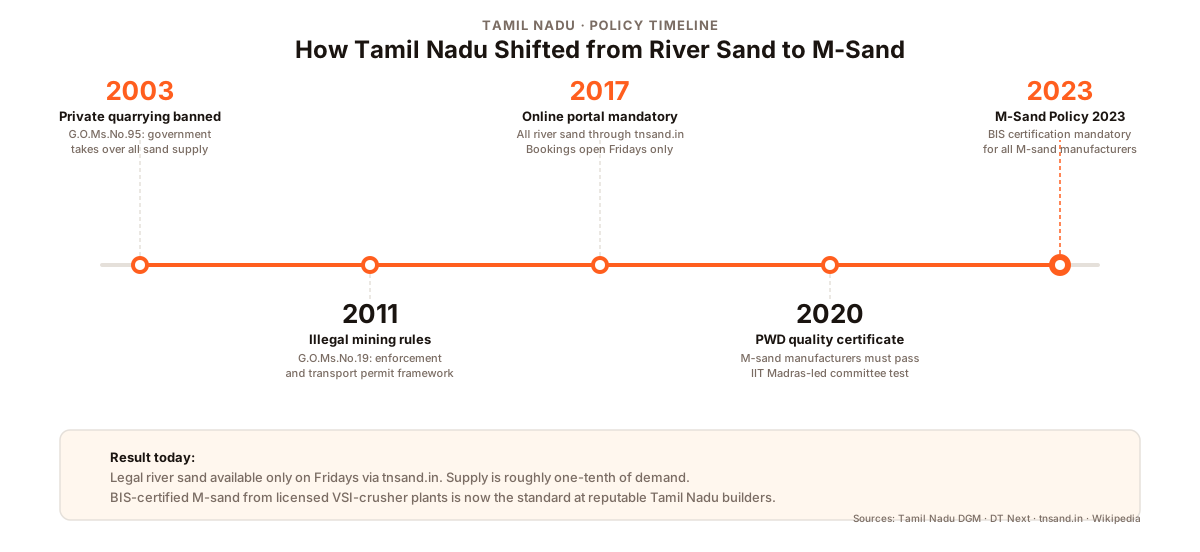
Legal river sand is now available only through tnsand.in, which at the time of writing opens for public booking on Fridays. Legal supply through this channel is roughly one-tenth of actual industry demand. That gap is what the M-sand industry has filled over the past decade.
Particle shape and silt: the two properties that determine quality
Two properties of sand affect a building most directly: particle shape and silt content.
Particle shape. Rounded river sand grains slide past each other easily, which makes concrete easier to mix and pour at a given water level. Angular M-sand grains grip each other and grip cement paste more tightly, which gives better mechanical interlocking in the hardened concrete.
A 2022 study published in Materials (PMC/NCBI) measured this: across different manufactured sands, more angular particles produced stronger concrete at 28 days, with the best-performing mix showing up to about 13 percent higher strength than the lowest-performing mix when all other conditions were kept equal.
There is a trade-off. Those same angular edges create friction, which means M-sand concrete needs more water than river sand concrete to reach the same pourable consistency. Concrete strength depends on the balance between cement and water: add too much water and the cement paste dilutes, producing weaker concrete. If a site worker simply adds extra water to restore workability, the strength benefit of the angular particle disappears. Well-managed construction handles this with a plasticiser, a small chemical additive that makes concrete flow easily without extra water, in the same way a little soap makes washing-up water feel slippier.
Silt content. This is the bigger concern in practice. Clay particles in sand coat each grain like a film, blocking cement from bonding to the aggregate. IS 383:2016 limits clay-silt to 3 percent for natural sand in concrete. River sand from unregulated sources, still widely available in the market, routinely carries five to fifteen times that amount. Studies show silt above the IS limit can reduce concrete compressive strength by up to 20 to 25 percent against the designed value. That means a column or wall built with high-silt sand may be weaker than the engineer planned, even when the rest of the site looks fine.
IS 383:2016 does allow manufactured sand up to 15 percent of material passing through the very finest sieve (75 microns, roughly the thickness of a human hair), but that limit covers non-plastic stone dust from the crushed granite. Stone dust does not coat sand grains or block cement bonding. It is not clay. Certified M-sand from a VSI plant typically tests below 1.5 percent actual clay-silt content.
Two grades: M-sand for concrete, P-sand for plastering
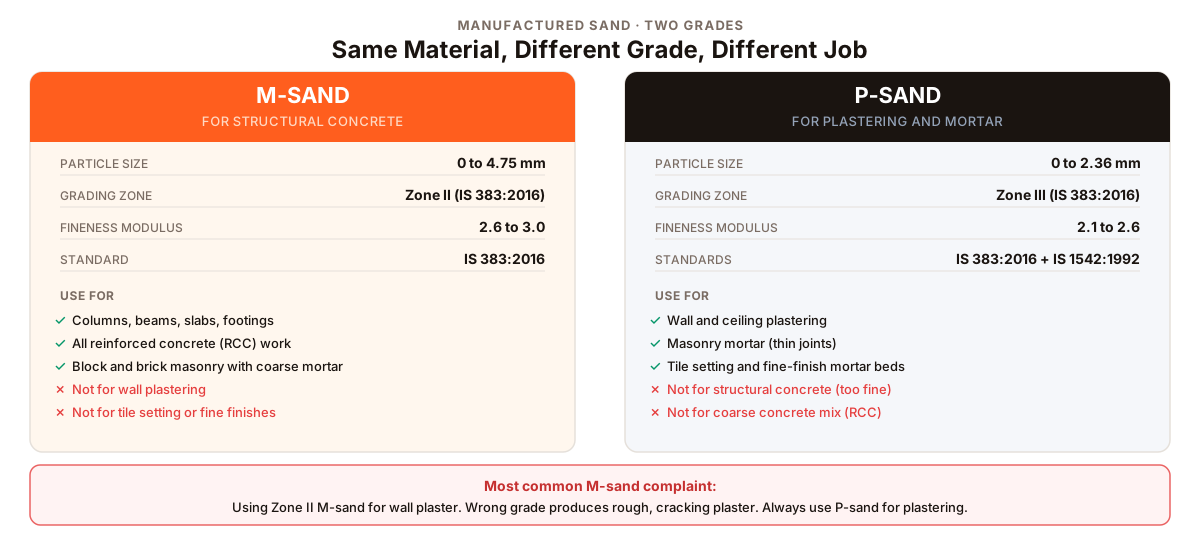
M-sand and P-sand are both manufactured sand. They are not interchangeable, and using the wrong one is the most common M-sand quality complaint on Tamil Nadu sites.
IS 383:2016 sorts fine aggregate into grading zones by particle size. Zone II is coarser; Zone III is finer. That size difference determines what each grade can do.
M-sand (Zone II): Particle size 0 to 4.75 mm, graded to Zone II of IS 383:2016. This goes into structural concrete: columns, beams, slabs, footings, all RCC (Reinforced Cement Concrete, the combination of concrete and steel rods that forms a building’s structural frame) work. The angular particle shape and controlled gradation give concrete the mechanical interlocking it needs.
P-sand (Zone III): All particles below 2.36 mm, graded to Zone III of IS 383:2016. P-sand also needs to meet IS 1542:1992, the BIS standard for sand for plaster. This goes into wall plastering and masonry mortar. The term P-sand is not in any BIS standard; it is the trade name used across Tamil Nadu and South India for the finer manufactured sand grade.
Using Zone II M-sand for plastering is too coarse for the job. The surface comes out rough and hard to finish, and the shrinkage crack risk goes up. This is not a flaw in M-sand as a material. It is what happens when the wrong grade is applied to the wrong surface.
A builder who keeps M-sand and P-sand as separate deliveries, stored in clearly labelled bays on site, is handling this correctly. Two grades, two sets of batch certificates.
What quality sand looks like
You do not need a laboratory to ask the right questions about the sand going into your home.
Batch test certificate. Any reputable M-sand supplier provides a test certificate with each delivery, showing sieve analysis (a particle-size breakdown that confirms whether the sand is Zone II or Zone III), silt content, and specific gravity (a density measure used to verify there is no contamination). Tamil Nadu’s M-Sand Policy 2023 requires manufacturers to test product at NABL-accredited laboratories every six months. NABL (National Accreditation Board for Testing and Calibration Laboratories) is the central government body that certifies independent testing labs. A NABL test result is not a seller’s self-declaration. Asking to see the certificate is a straightforward request.
BIS certification. Under the M-Sand Policy 2023, all licensed M-sand manufacturers must hold BIS certification for IS 383:2016. If the supplier is BIS-certified, the product has been independently checked against the standard.
Visual check. Good M-sand is consistently grey or off-white and feels rough and angular between your fingers. It should not clump when dry. River sand is smoother and rounder, usually warmer in colour. Sand that smells musty, feels greasy, or has dark patches is a warning sign for organic contamination.
Zone II for structural work. Asking your builder “are you using Zone II M-sand for the columns and slabs?” is a specific, answerable question. A builder with a well-documented materials process will answer it without hesitation.
What this means if you are buying in Salem
The Salem and Namakkal belt sits in granite country. M-sand manufacturing units operate in the region, and under the 2023 policy framework they must be BIS-certified and registered with the Directorate of Geology and Mining, the Tamil Nadu state body that licences quarrying units. Construction in Salem does not depend on sand travelling long distances from Chennai suppliers or the Cauvery basin. Local sourcing keeps cost lower and contamination risk during transport down.
The relevant question for a buyer is not whether the builder uses M-sand or river sand. It is whether the sand is certified, tested, and used in the right grade for each application. A builder who uses BIS-certified Zone II M-sand for the RCC structure and P-sand for plastering, with batch certificates for each delivery, leaves you with a paper trail.
The four questions to ask
When evaluating a project, ask these four questions:
- Do you use BIS-certified M-sand from a VSI crusher plant?
- Do you keep Zone II M-sand and P-sand as separate grades for concrete and plaster?
- Can I see a batch test certificate for the sand, from a NABL-accredited lab?
- Who is your M-sand supplier? (A named, BIS-certified unit means the certification and test records are traceable to a real producer, not a middleman who may not know the source.)
A builder running a well-managed site will answer all four without hesitation.
Chola Builders has been building homes in Salem since 1994. If you want to understand the materials and construction approach behind a specific project, call us or send a WhatsApp message. We are happy to walk you through it.
For a broader picture of Salem as a city, including how different areas and localities compare, read our guide to how Salem is laid out. If you are at the stage of evaluating a flat’s area and price, our guide on carpet area, built-up area and super built-up area explains those terms plainly.