Salem Connectivity: Airport, Junction, and the National Highways
Before a family chooses a city to settle in, they want to know: how easy is it to leave? Not because they plan to leave often, but because the answer tells them something about the city's position in the world. For Salem, the answer is encouraging.
Last verified against government sources on . We re-check this post whenever rules change.
In this guide, you'll learn
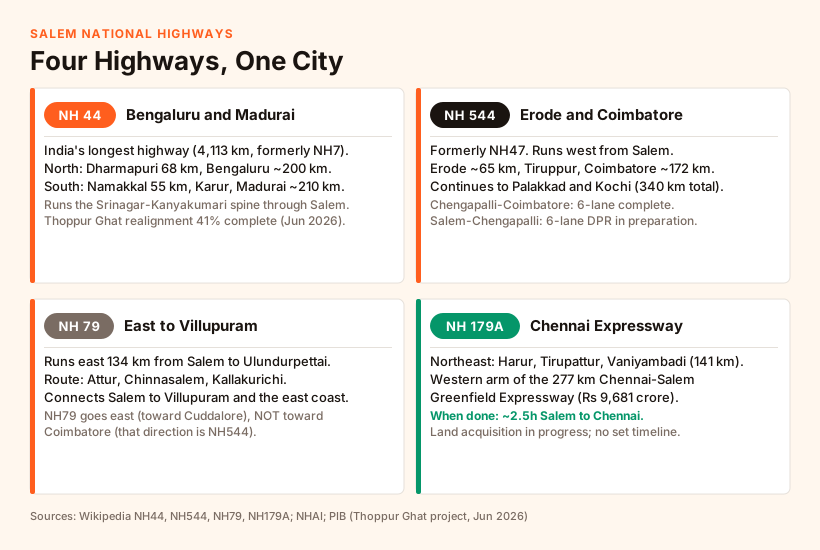
- Four national highways converge at or near Salem: NH44 (the former NH7, India's longest highway, linking Bengaluru to Salem in roughly 200 km and continuing south toward Madurai), NH544 (connecting Salem to Erode at about 65 km and Coimbatore at about 172 km, all the way to Kochi), NH79 (running east 134 km toward Villupuram and the Cuddalore coast), and NH179A (northeast toward Vaniyambadi, forming part of the future Chennai-Salem Expressway corridor).
- Salem Junction is the headquarters of the Salem Railway Division of Southern Railway. Five rail lines radiate from it in five directions. By Vande Bharat, Salem to Chennai takes about 3 hours 45 minutes, Salem to Bengaluru is under 4 hours, and Salem to Coimbatore is around 2 hours. There are also direct daily trains to Mumbai, Delhi, Hyderabad, and Ernakulam.
- Salem Airport (IATA: SXV) is about 20 km from the city centre, operated by the Airports Authority of India. IndiGo and Alliance Air (as of mid-2026) fly non-stop to Chennai, Bengaluru, Hyderabad, and Kochi. The airport is domestic only. The Tamil Nadu Budget 2025-26 allocated Rs 350 crore for land acquisition toward a three-phase expansion that will eventually allow jet operations and night landings.
- Salem's Central Bus Stand is the fourth-largest in Tamil Nadu, handling approximately 300,000 passengers a day. TNSTC Salem Division runs 2,188 buses across four districts (Salem, Namakkal, Dharmapuri, Krishnagiri) with services to Bengaluru in about 3.5 hours, Coimbatore in about 3 hours, and Chennai in about 5 to 7 hours depending on the route.
- A Chennai-Salem Greenfield Expressway of 277 km is under construction under Bharatmala Pariyojana (India's national highway development programme), budgeted at Rs 9,681 crore. When complete, it should cut road travel time between the two cities from the current 5 to 6 hours to about 2.5 hours. Land acquisition has caused delays; no confirmed completion date exists.
Before a family chooses a city to settle in, they want to know how easy it is to leave. Not because they plan to leave often, but because the answer tells them something about where the city sits in the country. A city well-connected by road, rail, and air is a city that the rest of the world takes seriously.
For Salem, the picture is more solid than most people outside Tamil Nadu expect. Four national highways converge here. Southern Railway made Salem the headquarters of its own division. The airport, small but functional, serves four domestic destinations under India’s UDAN regional connectivity programme. And the bus network reaches Bengaluru in under four hours.
Four National Highways at One Point
Salem sits where India’s north-south highway spine crosses the east-west route toward Kochi. That is not a coincidence; Salem has been a trading crossroads for centuries, and the national highway grid follows the same logic.
NH44 is India’s longest highway, 4,113 km from Srinagar in Jammu and Kashmir to Kanyakumari at the southern tip of Tamil Nadu. Before the 2010 renumbering it was known as NH7. Salem sits on the Bengaluru-Dharmapuri-Salem-Namakkal-Madurai section of this corridor. Bengaluru is about 200 km north on this highway, a drive of roughly 3.5 hours. Madurai lies about 210 km south.
NH544 (formerly NH47) is the road that connects Salem to the western Tamil Nadu cities. It begins near Salem and runs through Erode (about 65 km), Tiruppur, Coimbatore (about 172 km), and into Kerala via Palakkad, ending at Kochi. For families with ties to Erode or Coimbatore, this is the daily-use highway.
NH79 runs east from Salem for 134 km toward Kallakurichi, Chinnasalem, and Ulundurpettai in Villupuram district. It provides Salem with access to the eastern coast of Tamil Nadu.
NH179A is the newest designation in Salem’s highway geography. It runs northeast from Salem through Harur and Tirupattur to Vaniyambadi (141 km). Its importance exceeds its length: it forms the western arm of the Chennai-Salem Greenfield Expressway currently under construction.
The Chennai Road: Current and Coming
Chennai, the state capital, is the destination most families ask about first. By road today, Salem to Chennai is about 340 to 345 km, taking 5.5 to 6.5 hours depending on the route and traffic. You travel NH44 toward Krishnagiri or use NH79 toward Villupuram, then connect on state roads or NH48 into Chennai.
The Chennai-Salem Greenfield Expressway, when complete, will change this. It is a 277 km six-lane access-controlled expressway budgeted at Rs 9,681 crore under the Bharatmala Pariyojana, India’s national highway development programme. The promised travel time is 2.5 hours. Construction has begun on sections but land acquisition disputes have caused delays. No confirmed completion date is available as of mid-2026. The Thoppur Ghat section on NH44 (the accident-prone hill stretch between Salem and Dharmapuri) has a separate Rs 905 crore realignment project underway; as of June 2026 it was 41% complete, with March 2028 as the construction target. Until then, the Vande Bharat train is the faster option for most travellers between Salem and Chennai.
Salem Junction: Where Five Lines Meet
Salem Junction (station code: SA) is not just a stop on someone else’s route. It is the headquarters of the Salem Railway Division of Southern Railway, a fact that tells you something about how Indian Railways thinks of Salem. The division was carved out as its own unit in November 2006, covering 862 km of track across 15 Tamil Nadu districts.
The station has six platforms and eight tracks. Five rail lines radiate from it: toward Chennai (northeast), toward Coimbatore (west), toward Bengaluru via Dharmapuri (north), toward Vriddhachalam (east), and toward Mettur Dam (northwest). Approximately 50,000 passengers move through Salem Junction on a typical day.
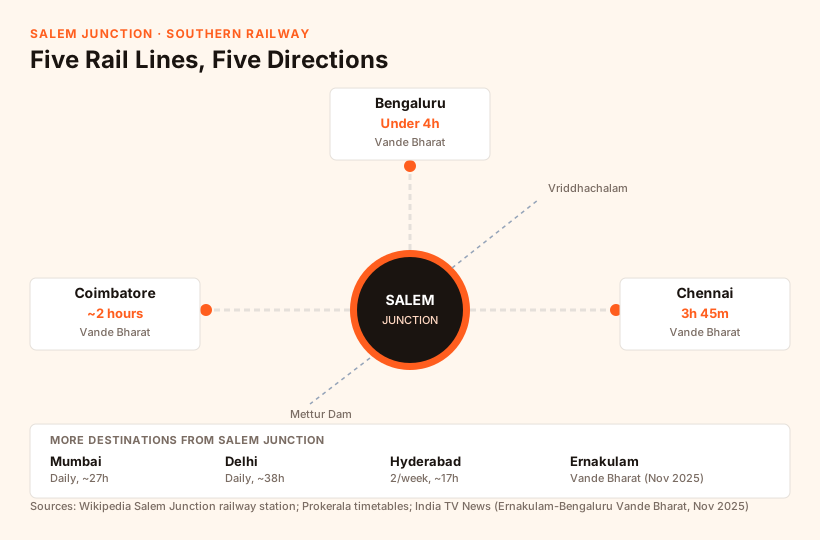
The Vande Bharat services are the practical headline for families considering a move to Salem. Chennai in under four hours by train means a Salem resident can be in Anna Nagar for a hospital appointment and back home for dinner. Bengaluru in under four hours means a family whose earning member works in Electronic City or Whitefield has a commute option, though most would not do it daily.
The Cheran Superfast, the Nilgiri Superfast, and the Shatabdi Express are among the named trains that stop at Salem. For families travelling to Mumbai, Delhi, or Hyderabad, Salem Junction has direct trains, though journey times are long, as they are from any Tamil Nadu city.
Salem Airport: Regional, Growing, Practical
Salem Airport (IATA: SXV) sits at Kamalapuram in Omalur Taluk, about 20 km south-west of Salem city centre. The drive takes 30 to 45 minutes depending on traffic.
The airport is small by Tamil Nadu standards. The terminal handles about 100 passengers simultaneously. The single runway is 1,806 metres long, which accommodates smaller regional aircraft but not the larger jets used on busier domestic routes. Operations are daytime only.
Sources: AAI Salem Airport page; Wikipedia Salem Airport (India); DT Next TN Budget 2025-26 coverage; Salem District Government
As of mid-2026, IndiGo and Alliance Air serve four domestic destinations: Chennai, Bengaluru, Hyderabad, and Kochi. All services run under India’s UDAN (Ude Desh Ka Aam Nagarik, “let the common citizen fly”) regional connectivity scheme, which subsidises fares on underserved routes to keep flying accessible. Salem Airport handled approximately 127,000 passengers in the financial year 2025-26.
The expansion picture is real. The Tamil Nadu Budget for 2025-26 allocated Rs 350 crore for land acquisition toward a three-phase expansion of the airport. The plan involves extending the runway to about 3,200 metres, which would allow larger jets and eventually night operations. Land acquisition has involved some dispute with affected villagers in four areas. The expansion is funded and planned, but no completion timeline has been officially confirmed.
For travellers going to Chennai or Kochi from Salem, the airport is a practical choice when flights align with plans. For those who need Chennai regularly, the Vande Bharat train is more predictable and often more convenient given city-centre-to-city-centre timing.
Buses: The Everyday Connection
The national highways and the railway junction are the headline infrastructure. The buses are the everyday reality.
Salem’s Central Bus Stand (officially Bharat Ratna Dr. M.G.R. Central Bus Stand) is the fourth-largest in Tamil Nadu, handling approximately 300,000 passengers a day from a 5.9-acre site on Omalur Main Road. It is 3 km from Salem Junction. The TNSTC Salem Division, headquartered here, runs 2,188 buses across Salem, Namakkal, Dharmapuri, and Krishnagiri districts, covering about 9.19 lakh km every day.
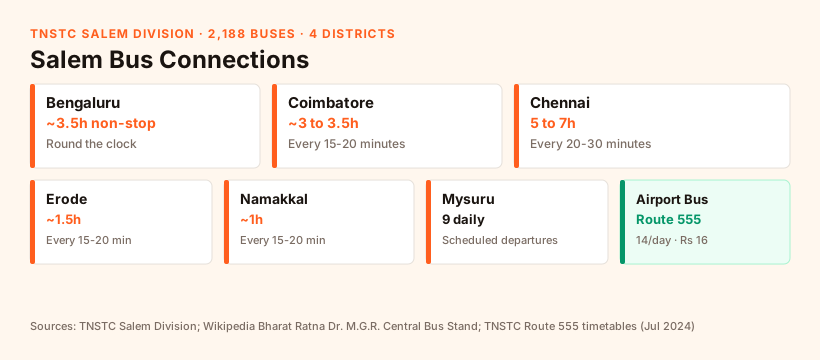
The TNSTC non-stop “3.33 Electronic City Express” to Bengaluru runs several times a day and takes about 3.5 hours, which is competitive with the train for many travellers. Buses to Coimbatore and Erode are so frequent they barely need a timetable; you can walk to the stand and be on the next one within 20 minutes at most hours.
Salem also has a second bus terminal: the Kalaignar Salem City Double Decker Bus Terminus, rebuilt under the Smart Cities Mission at Rs 92.13 crore and now handling about 1,75,000 daily commuters across 180 bays on two floors. It handles primarily city and town services.
What This Means When Choosing Where to Live in Salem
The transport network shapes which parts of Salem are most practical to live in, depending on how a family moves.
Families who travel frequently to Bengaluru (for work, family, or medical appointments) tend to prefer the northern localities: Fairlands, Suramangalam, and Swarnapuri all lie along the NH44 corridor and give quick access to the Bengaluru highway exit. Families with strong ties to Coimbatore or Erode find the western side of Salem, toward Omalur and Sankagiri, makes those road journeys shorter.
For rail travel, the station sits near the centre of the city and is easily reached from most Salem localities. The Central Bus Stand is three kilometres from Salem Junction, making a transit switch between the two simple.
Salem Airport sits south-west of the city. The Route 555 airport bus passes through Salem Junction and several residential areas, which helps families without private vehicles.
Putting It Together
Salem is not trying to compete with Chennai’s flyovers or Bengaluru’s metro. It is a mid-size inland city that happens to sit at a genuine crossroads: India’s longest highway passes through it, five rail lines radiate from it, four domestic air routes serve it, and buses to Bengaluru, Chennai, and Coimbatore run round the clock.
Getting to Chennai or Bengaluru for a medical appointment or a family visit takes under four hours. Coming back is just as easy. For most families who move here, that turns out to be enough.
We have been building homes in Salem since 1994 and we know the city’s localities well. If you want to talk about which part of Salem makes most sense for your family, call us or send a WhatsApp. We are happy to walk you through it.
Related reading: For a closer look at how Salem’s neighbourhoods are laid out and which areas suit different family needs, see our Salem city areas guide. If you are considering Salem from a lifestyle perspective rather than a transport one, why families are moving to Salem covers schools, hospitals, and cost of living. And if you are thinking about where the city is headed over the next decade, Salem’s growth corridors maps out the expanding edges.