TMT Steel in Your Home: What the Grades Actually Mean
Walk onto any residential construction site in Tamil Nadu and you will see bundles of ribbed steel bars stacked at the edge of the plot. Most buyers walk past them on their way to the model flat. Understanding what those bars are, and why the grade stamped on each one matters, takes about ten minutes and tells you a great deal about how the building will hold up over the next fifty years.
Last verified against government sources on . We re-check this post whenever rules change.
In this guide, you'll learn
- TMT stands for Thermo-Mechanically Treated. Bars are made by quenching hot-rolled steel in water jets, forming a hard outer shell of tempered martensite around a ductile inner core of ferrite-pearlite. That combination gives the bar both strength and the ability to bend visibly before it fractures.
- The number in a TMT grade name is the minimum yield strength in N/mm2. Fe-415 must yield at 415 N/mm2 or more; Fe-500 at 500 N/mm2 or more. A structural engineer chooses the grade based on the calculated load each column and beam must carry.
- The D suffix in grades like Fe-500D means enhanced ductility. Fe-500D must stretch at least 16 percent before fracturing, compared to 12 percent for plain Fe-500. That extra stretch gives a structure time to show visible distress before a failure, which is critical in earthquakes.
- Fe-500D is the grade most commonly specified for residential apartments in Tamil Nadu today. It satisfies IS 1786:2008 (the BIS standard for reinforcement steel) and aligns with IS 13920:2016 (the ductile detailing code applied in seismically active zones).
- BIS certification for TMT bars is mandatory under the Steel and Steel Products Quality Control Order 2024. The ISI mark on a genuine bar is rolled directly into the steel during manufacturing, not painted on. The bundle tag carries a CM/L licence number you can verify in the free BIS Care app.
- Asking your builder for the mill test certificate for the steel batch used on your plot is the most practical quality check available to a home buyer. The certificate records the actual yield strength, elongation, and chemical composition of that specific batch.
Every TMT bar delivered to a construction site carries grade markings embossed into the metal during rolling: a number (415, 500, 550) and sometimes the letter D. These marks look like technical detail. They are a structural specification that determines how your home will perform for the next fifty years.
Those bars are the skeleton of the building. Concrete forms the bulk, but it cracks under tension. Steel does not. A beam carrying a floor slab is under tension on its lower face. A column pushed sideways by an earthquake is under tension on one side. The steel handles these forces so the concrete does not have to. Getting the grade right is near the top of what a builder gets right or gets wrong.
What RCC means and why steel is inside it
RCC stands for reinforced cement concrete. Plain concrete is strong in compression but breaks easily in tension. Steel does the opposite: it is highly resistant to tension and can bend without fracturing. When you embed steel bars in concrete, the two materials work together. Concrete carries the compressive loads; steel carries the tensile ones.
In a typical residential apartment, TMT bars run through every column (the vertical elements that carry the building’s weight to the ground), every beam (the horizontal elements that carry the floor slabs), and every slab itself. They also run through walls where structural reinforcement is needed.
The quality of this steel is therefore not a cosmetic concern. It determines how the building behaves over decades, including under the loads it was not originally designed for.
What changed from the old TOR bars
Through the 1990s and into the early 2000s, most residential construction in India used a type of reinforcement called TOR bars (also known as CTD bars, cold-twisted deformed). They were made by taking hot-rolled plain steel rods and twisting them at room temperature after rolling. The cold twisting deformed the surface, creating ribs, and also work-hardened the steel, which raised its yield strength.
The problem was what the twisting did to the bar’s other properties. Cold working reduced ductility: the bars were stronger but also more brittle, meaning they had less capacity to bend before fracturing. The twisting also broke the natural oxide layer on the bar surface, which provided some passive protection against moisture. CTD bars were, consequently, more prone to rust than the bars that replaced them.
TMT bars achieve their strength through heat, not mechanical deformation. Because the surface is not cold-worked, ductility and the protective oxide layer are both preserved.
The structure inside a TMT bar
The manufacturing process that defines TMT happens in the final few seconds as a bar exits the rolling mill.
The bar leaves the rolling mill at roughly 1,100 degrees Celsius. At that temperature, steel is soft and workable.
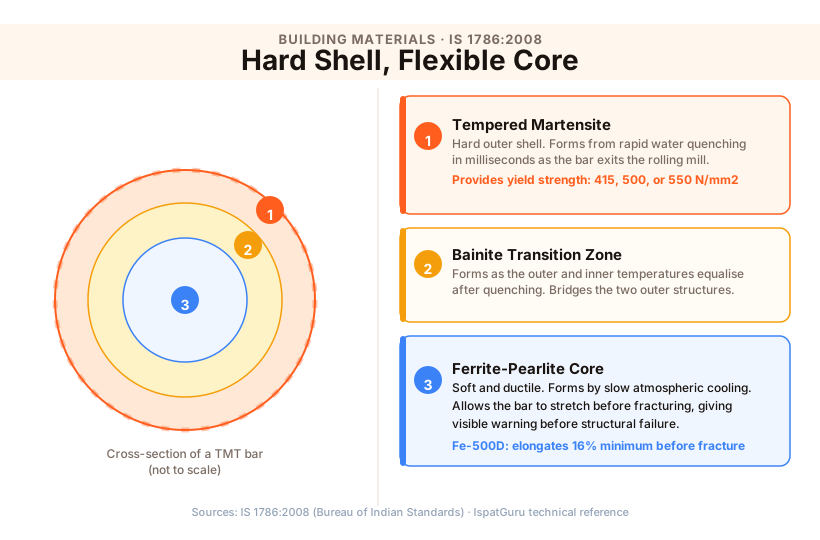
It then passes through high-pressure water jets. The surface cools in milliseconds, forming a very hard outer layer called tempered martensite. The inner core, insulated by the surrounding metal, stays hot.
Once the bar clears the water jets, the core heat flows outward. This heat tempers the hard outer surface, making it less brittle, so it can take a knock without cracking. This is the self-tempering stage, and it happens in seconds.
On the cooling bed, the inner core cools slowly on its own. It becomes soft and flexible, the structural quality called ductility.
The finished bar has a hard outer shell that provides strength and a flexible inner core that allows it to stretch before fracturing. The bar is strong and ductile at once.
What the grades mean: Fe-415 to Fe-550D
“Fe” is the chemical symbol for iron. The number that follows is the yield strength, measured in N/mm² (newtons per square millimetre). Think of it as how much load per square millimetre of cross-section the bar can handle before it permanently bends. A bar rated at 500 N/mm² can carry more load than one rated at 415 before it reaches that point.
IS 1786:2008 defines several grades. The ones relevant to residential construction are:
- Fe-415 and Fe-415D: 415 N/mm² minimum yield strength
- Fe-500 and Fe-500D: 500 N/mm² minimum yield strength
- Fe-550 and Fe-550D: 550 N/mm² minimum yield strength
Fe-600 is also defined in the standard, but it is used in bridges, flyovers, and large industrial structures, not in homes.
A structural engineer calculates the loads that each column, beam, and slab must carry. They then select the concrete grade and steel grade combination that meets those loads with an appropriate safety margin. The grade is not a preference; it is an engineering specification that flows directly from the load calculation and the building code being followed.
Why the D suffix matters for a home
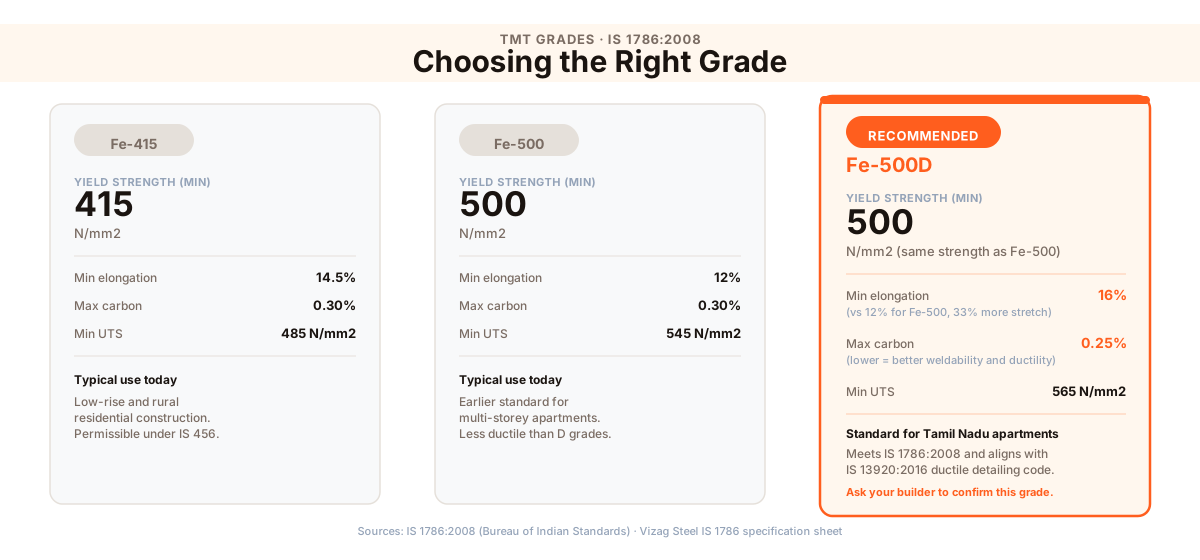
The D suffix in Fe-500D means enhanced ductility. The grade shares the same minimum yield strength as plain Fe-500, at 500 N/mm², but has a higher minimum elongation requirement: 16 percent versus 12 percent for Fe-500.
Elongation, in this context, is the percentage increase in a bar’s length between when it starts to yield and when it actually fractures in a tensile test. It is a measure of how much warning the material gives before it fails.
A bar with 16 percent minimum elongation will visibly deform, bowing and cracking the surrounding concrete, before it fractures. A bar with only 12 percent minimum elongation will also deform, but with less stretch between yield and fracture. In a structure under extreme loading such as a significant earthquake, the difference matters: the more ductile bar gives occupants more time.
Fe-500D also has a lower maximum carbon content (0.25 percent versus 0.30 percent for Fe-500) and stricter limits on sulphur and phosphorus. Fewer impurities mean the bar welds more cleanly at joints and lap splices (the spots on site where two bars are overlapped and tied together to carry a load across a longer span).
Fe-550D is used in taller or more heavily loaded structures where the engineer’s calculations call for the higher yield strength. It costs more per tonne, which is a real factor in project economics, but the extra strength is only useful if the loads genuinely demand it. Using Fe-550D in a four-storey apartment where Fe-500D would serve is not a quality statement; it is an unnecessary spend that may or may not reach the structure.
How to read the ISI mark on a bar
Every TMT bar produced under a BIS licence must carry the ISI mark embossed directly into the steel. That means the markings are raised ridges on the bar surface, formed during rolling. They are not paint and they cannot be removed without grinding.
A genuine ISI-marked bundle also carries a paper tag with the manufacturer’s CM/L number: a unique Certification Marks Licence number assigned by BIS. This number is the key to verification.
The BIS Care app (free, available on Android and iOS) lets you enter the CM/L number and query the live BIS database. The result tells you the manufacturer’s name, the IS standard covered (it should show IS 1786:2008), the licence validity date, and the specific grades and bar diameters covered. A licence for Fe-500 does not automatically cover Fe-500D; that is a separate variety and both should appear on the licence if the builder is specifying Fe-500D.
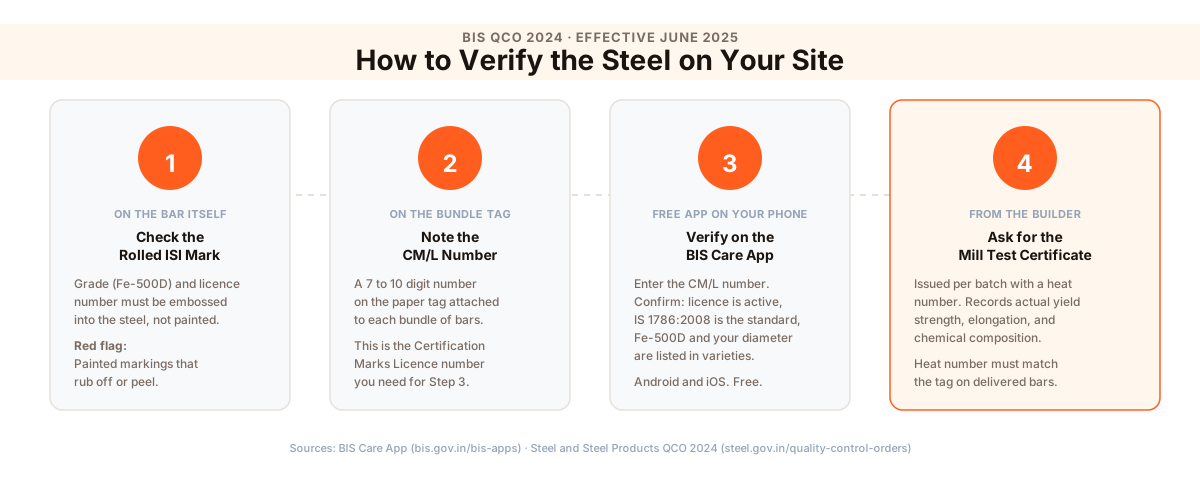
The Steel and Steel Products Quality Control Order 2024, which took effect in June 2025, makes this verification framework legally compulsory. A supplier who cannot produce a CM/L number or refuses to provide a mill test certificate (MTC) is operating outside the rules now in force.
Putting it together: three questions worth asking
The theory above is useful background. In practice, a home buyer is not reviewing structural drawings or weighing bar samples. You are asking questions and listening to the answers.
Three questions any reputable builder will answer without hesitation:
1. “What TMT grade are you specifying, and can I see the structural engineer’s drawings that confirm it?” A reputable builder has approved structural drawings. The drawings will specify the concrete grade (M20, M25, M30) and the steel grade (Fe-500D or similar) for each element. Seeing the specification on paper, rather than taking a verbal answer, costs nothing.
2. “Can you give me the BIS CM/L number for the steel supplier, so I can verify it on the BIS Care app?” This is a routine request that any licensed supplier handles in two minutes. A hesitation or an inability to produce the number tells you something.
3. “Can I have the mill test certificate for each batch of TMT delivered to this project?” The MTC is the document that connects the ISI mark on the bar to the actual properties of the material in your walls. Good builders file these routinely. If you are buying an apartment under construction, you can ask this during the agreement stage and request that copies be included in your handover file.
The steel and the fifty years ahead
The steel that goes into the columns and beams during construction will be inside those walls for fifty years or more. The concrete can be patched. The interior can be renovated. The steel cannot be reached.
This is why the grade matters now, during the build. A builder who can answer those three questions without hesitation understands that quality conversations belong at the foundation stage.
At Chola Builders, we have been building homes in Salem since 1994. The materials we specify, and the documentation we keep on every project, are part of what we mean when we say a home will last. If you would like to understand what goes into one of our buildings in more detail, call us or send a WhatsApp message.
For related reading, the post on M-sand and river sand covers the other key material in every concrete pour, and how Salem’s residential areas are laid out helps you think about location alongside construction quality.