Villa or Apartment for Retirement? What Suits a 55+ Couple
Both give you ownership. The villa gives you your own gate and garden. The apartment gives you a lift and less to maintain outside. At 55, both feel fine. At 72, one of them matters more.
Last verified against government sources on . We re-check this post whenever rules change.
In this guide, you'll learn
- A villa gives you your own gate, garden, and a single floor to live on. An apartment in a 55-plus community gives you lift access and no outdoor upkeep to worry about.
- At 55, most couples can manage either home comfortably. The choice shifts between 65 and 75, when knee and mobility difficulties become more common. A large national study of older adults found that difficulty with everyday tasks jumps sharply in that decade.
- The outdoor maintenance burden of a villa grows with age. A managed 55-plus campus handles shared landscaping and perimeter security, but your private garden and villa exterior remain your own.
- On a well-run campus, meals, nursing, the temple, and events are the same for villa residents and apartment residents alike. The private garden and the lift are what differ.
- Maghilvanam, a Vilva Homes 55-plus campus in Salem's Yercaud foothills, has both villas and Kaveri Block apartments on the same campus. You can walk both in one visit before deciding.
Most couples decide they will sort this out after they visit the campus. Then the visit happens, they like both home types, and the decision comes home with them unresolved.
This is the question most couples put off. They think they have time. Then a knee starts bothering them, or they notice how often they skip the garden because bending is difficult, or they realise they have been meaning to repaint the compound wall for two years.
This post lays out the honest tradeoffs. Not about which is “better.” About which suits you better, based on how you expect to live over the next fifteen years.
If you are still working out what a 55-plus community is, read senior living in Tamil Nadu first.
What a villa gives you
A villa in a 55-plus community is still a house. You have your own gate, your own garden path, your own four walls. You step out of your front door into open air, not a shared corridor.
In a well-designed villa, everything you need daily sits on the ground floor: bedroom, bathroom, kitchen, sitting area, all on one level, with no internal staircase to navigate. That single-floor living is the feature that matters most at this stage of life.
No shared walls means no footsteps from the flat above at six in the morning. Your garden is yours, not a common lawn. When grandchildren visit for the weekend, they have a gate to run out of and ground to play on.
The harder fact is the one that costs money later: the exterior is yours. In a 55-plus campus, the perimeter roads, common landscaping, and shared infrastructure are maintained by the campus collectively. But your private garden, your terrace, your exterior walls, your gate: those remain your own.
What an apartment gives you
In an apartment block inside a 55-plus community, you own your flat. Outside your front door, everything is shared.
The lift is the first thing. You never use the staircase unless you choose to. If your knee is bad, if you are using a walker, if you have had a fall, you press a button and step out at your floor. A nurse coming to check on you can reach your landing in minutes. A stretcher can reach your door.
Outside your door, the corridor, the stairwell, the lift, the maintenance: all shared, all handled. You pay a monthly maintenance charge. The terrace, the exterior walls, the facade: not your problem. That is the apartment association’s job.
The corridor is also a quiet social net. You see your neighbours when you step out for water or mail. You do not have to plan a visit or walk to the clubhouse to make contact. The flat opposite yours is ten feet away.
What you give up is outdoor space. Common gardens and the walking track exist, but they are shared with the whole campus. You do not have a private garden or sit-out.
Two questions worth answering before you pay an advance
Both questions come from how people actually live in their 70s, not from how they feel at 55.
First: how confident are you about mobility in your 70s?
Most 55-year-old couples can manage either home comfortably today. The question is what happens at 72.
India’s Longitudinal Ageing Study, which tracked more than 31,000 adults aged 60 and above, found that difficulty with everyday tasks jumps sharply between the 60s and 70s. About 39% of people aged 60 to 69 struggle with at least one everyday task such as cooking or managing errands. By ages 70 to 79, that figure climbs to 52%. Knee problems are among the biggest reasons. A study of rural Tamil Nadu adults found that about 35% of people over 40 have knee osteoarthritis, and pain on climbing stairs was among the highest complaints.
A ground-floor villa means you never need a lift. If your knees worsen, your home stays fully accessible. That is the villa’s clearest practical advantage at this stage of life.
An apartment on an upper floor means you depend on the lift working. Ask the campus directly: is there power backup for the lift, who maintains it, and what happens when it goes out? A campus that cannot give you a clear answer on this is a concern.
Second: how much outdoor maintenance do you want to manage?
A villa’s garden and exterior walls belong to you. At 55, a garden feels like a pleasure. At 72, watering, trimming, and keeping the compound presentable can become a task that needs reliable hired help every month.
An unmanageable garden does more than drain money. Studies on elderly homeowners found that when a garden becomes too much to handle, it affects mood and sense of independence in ways that are harder to recover from than the financial cost alone.
A 55-plus campus reduces the burden: shared landscaping and roads are maintained centrally. But your private garden, your villa terrace, and your exterior walls remain yours. Ask the campus exactly what they cover.
An apartment has no private garden and no exterior to maintain. Whatever is outside your front door is the apartment association’s responsibility.
On a 55-plus campus, the gap is smaller than it looks
If you are comparing a standalone private villa against a regular city apartment, the differences above are wide. On a purpose-built 55-plus campus, some of those gaps close.
A good campus provides daily meals so you are not cooking three times a day. A nurse is on campus around the clock. An ambulance is on standby. A temple is on the grounds so morning pooja does not need a driver. There is a calendar of events so there is always a reason to leave the house.
That context matters for both home types.
Social life. An ethnographic study of an Indian senior living campus found that daily social contact comes primarily from shared meals, the temple, the event hall, and campus pathways: not from which type of home you live in. An apartment corridor means you see neighbours every time you step out. A villa path means you walk to the clubhouse and find people there. Morning walks and shared meals matter more than which home type you choose.
Emergency reach. On a campus with a 24-hour nurse and ambulance on standby, both villa residents and apartment residents have faster access to care than they would in a regular neighbourhood. The campus makes this true for both.
What stays different between the two home types, even on a good campus:
What senior-friendly design looks like in either home
Whether villa or apartment, certain design features matter once you are past 60. India’s National Building Code 2016 and the Union government’s guidelines for registered retirement home projects both specify minimum requirements:
- Doorways at least three feet wide (about 900 mm), enough for a walker or wheelchair to pass
- Anti-skid tiles throughout wet areas
- Grab bars in the bathroom and near the toilet
- Bathroom doors that open outward, so a family member or nurse can open the door if you fall inside
- Step-free or gently ramped thresholds between rooms
- Emergency call points in the bedroom and bathroom
These apply to both home types in a registered project.
Ordinary Indian housing rarely has any of these. A study of 198 bathrooms used by older adults in western India found that 97% had no grab bars and 91.9% had slippery floors. A purpose-built 55-plus campus is supposed to fix that. Ask to see a real occupied unit, not only the model flat, and check the bathroom yourself.
What stays different on a bad day: a ground-floor villa stays fully accessible whether or not any external system is working. An apartment on an upper floor depends on the lift. In a well-run campus with proper backup, this is a managed risk rather than a daily one. Confirm the backup before you sign.
What this looks like in Salem
Maghilvanam is a Vilva Homes 55-plus campus at Vinayagam Patty, in the Yercaud foothills, about ten minutes from Hasthampatti.
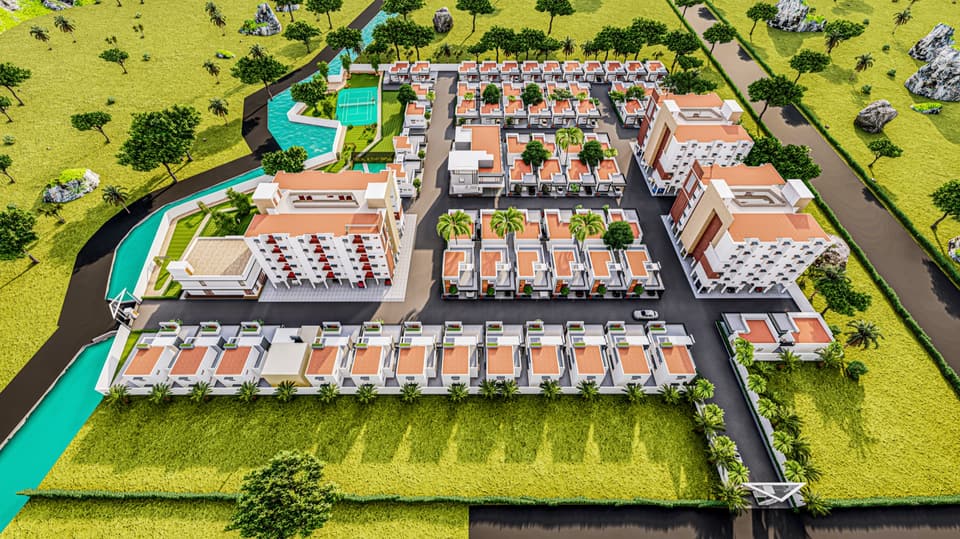
The campus has both home types on the same grounds. Two BHK and 3 BHK villas, with families already living in them. Kaveri Block: thirty 2 BHK apartments with lifts, the first of three apartment blocks planned. You can walk both types on the same afternoon.
The campus services are shared by everyone, villa or apartment: three vegetarian meals a day from a common kitchen, a spiritual centre with a temple, a multi-purpose hall for about 250 people, a pool, a gym, a library, 24x7 gated security, 24x7 nursing and a clinic, a 24x7 ambulance, and Sharon Hospital adjacent to the campus.
Tamil Nadu RERA registration numbers for Maghilvanam: TNRERA/7/REGLO/0764/2025 (campus) and TNRERA/7/BLG/0363/2025 (Kaveri Block). You can verify both on rera.tn.gov.in before you pay.
Full walkthrough of the campus: Maghilvanam by Vilva Homes.
Choose before you visit: a simple frame
Choose a villa if you want your own garden and private outdoor routine, feel confident about your health through your 70s, and prefer the feel of a house with your own gate.
Choose an apartment if lift access matters to you now or in a few years, you want no outdoor upkeep at all, and you are comfortable with neighbours a short corridor away.
In Salem, Maghilvanam gives you the rare option of deciding in person. Walk a villa. Walk a Kaveri Block flat. Eat a meal in the common dining hall. Talk to the families already living in the villas. Then decide.
If you want to visit Maghilvanam, call or send a WhatsApp to arrange a time. Chola Builders has worked in Salem since 1994.
For a broader picture of senior living in Salem, read senior living in Salem. For the full checklist of what a good 55-plus campus must have, read what to look for in a senior living home. If you are a child or NRI buying for your parents, read can children buy a home in a 55-plus community.