Apartment, Villa or Plot: Which One Is Right for Your Family?
Three property types, three very different lives they will give you. Here is an honest look at apartments, villas, and plots so your family can think through the choice without the noise of a sales pitch.
Last verified against government sources on . We re-check this post whenever rules change.
In this guide, you'll learn
- An apartment gives you a ready home with pooled maintenance and a community, but no directly owned land parcel and a floor plan you cannot expand after possession.
- A villa gives you full ownership of a demarcated plot, the option to add a floor later under FSI rules, and the generational zoning a joint family often needs, at the cost of carrying all maintenance yourself.
- A plot gives you the lowest entry cost and full design control, but you need time, energy, and a licensed contractor to build, and home loans for plots are harder to get with lower LTV and no tax benefit until the house is built.
- For home loans, apartments are easiest to finance (up to 90% LTV), villas follow on similar terms, and plot loans are capped at 70 to 75% with tax deductions deferred until construction is complete.
- For elderly parents or buyers aged 55 and above, a managed apartment with a reliable elevator removes maintenance burden and provides round-the-clock security that a standalone house does not.
- In Tamil Nadu, every residential plot layout must carry DTCP approval. An unapproved plot cannot legally receive electricity, water, or sewerage, and construction on it can be demolished by the local authority.
Your family has been going back and forth on this for a while. Someone wants a flat in a gated complex. Someone else keeps circling back to an independent house with a bit of land. And someone in the room occasionally brings up buying a plot and building from scratch.
All three are real options. None is obviously wrong. The question is which one fits your family’s stage, your way of living, and where you want to be in ten or fifteen years.
Read it before you visit a site or attend a builder’s presentation. It will help you walk in knowing what to weigh.
What You Actually Own in Each Case
The three types differ at the level of ownership structure, not just what you live in.
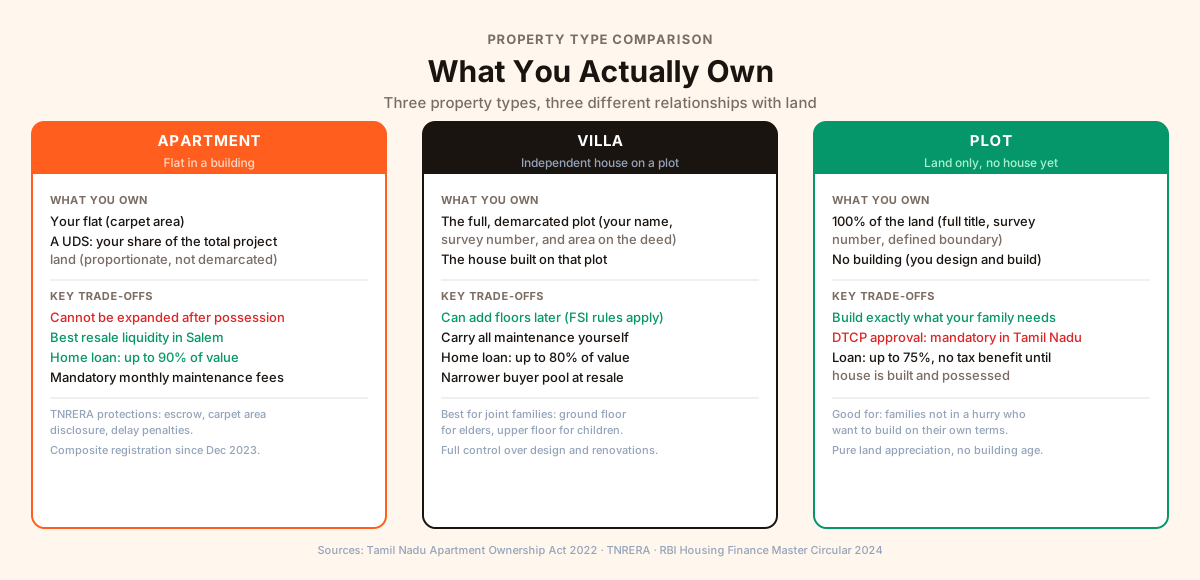
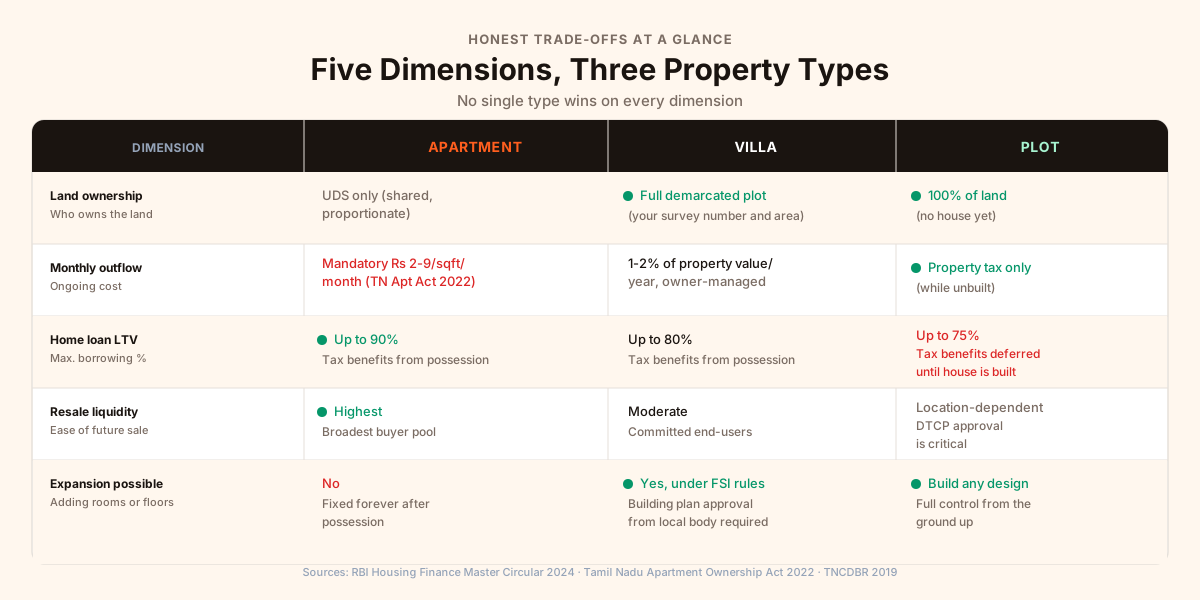
When you buy an apartment, you own two things: a UDS (undivided share of land), which is your proportionate fraction of the project’s total plot registered in your name, and your individual flat. You do not own a physically marked, fenced piece of ground. In a building with twenty units, your UDS might be around five percent of the land. That share is yours in law and on the sale deed, but it cannot be pointed at or walked around. Think of it as a percentage stake in the land, not a physical patch you can fence off. Since December 2023, Tamil Nadu combines both the UDS and the flat in a single composite registration document, which has simplified the paperwork considerably.
When you buy a villa or independent house, you own the full, demarcated plot on which it stands. Your name is on the title for a specific land extent (a survey number and area in square feet). The house sits on your land. You can extend the house upward, subject to FSI rules (Floor Space Index: the ratio of total built area the rules permit relative to your plot area; most residential zones in Tamil Nadu allow 2.0, meaning a 1,200 sq ft plot can support up to 2,400 sq ft of built space across all floors), without needing approval from other residents.
When you buy a plot, you own land only. No house comes with it. You start with the lowest cost, the most design freedom, and the most time before you move in.
Apartment: What It Gives You, and What It Doesn’t
A flat in a managed gated complex is the most straightforward ready home. You move in. The security guard at the gate is there from day one. The common areas (corridor, lift, car park, landscaping) are maintained by the residents’ association. If a pipe in the overhead tank bursts at night, that is the association’s repair to organise, not yours to chase a plumber for at midnight.
For an elderly parent living alone or a family where both adults work long hours, managed maintenance and round-the-clock security matter far more in practice than they appear to when reading a brochure.
What you get:
- A ready, finished home with no construction to manage
- Pooled maintenance for everything outside your front door
- 24-hour security with CCTV and a gate log in most gated complexes
- TNRERA (Tamil Nadu Real Estate Regulatory Authority) protections: your funds go into an escrow account (a protected holding account the builder can draw from only as construction milestones are met), delays trigger financial penalties, and the carpet area (what you actually live in) must be disclosed upfront
- Elevator access in multi-story buildings, which is genuinely important once knees or heart health become a consideration
What you give up:
- Direct land ownership. Your UDS is a legal share, not a physical one.
- The option to expand. An apartment is fixed in size permanently. A second child, a parent moving in, a work-from-home room that did not exist before: none of these can be solved by adding space.
- Any change to structural walls, the facade, or anything affecting common areas needs sign-off from the residents’ association. You cannot act on these independently.
- An ongoing mandatory cost. Maintenance charges under the Tamil Nadu Apartment Ownership Act 2022 cannot be opted out of. For a 1,200 square foot flat with moderate amenities in Salem, budget roughly Rs 2,000 to 5,000 per month.
Villa: What It Gives You, and What It Doesn’t
A villa (independent house) on its own plot is the closest equivalent to owning land and a home together in one title. The plot is yours, named in your deed, with a survey number and a defined boundary.
For a joint family where three generations live together, this matters deeply. A two-floor villa lets the grandparents live entirely on the ground floor (their bedroom, bathroom, a sitting area, and garden access) while the younger family occupies the upper floor. The two generations share meals and share the address, but each floor has its own rhythm. This generational zoning is almost impossible to replicate in a flat, where all bedrooms sit at the same elevation separated only by doors.
What you get:
- Full land ownership: the plot is yours, named and mapped on a government document
- Future expansion: add a floor when the family grows, with building plan approval from the local body, as long as FSI allows it
- Privacy with no shared walls, no neighbour overhead, no shared staircase with strangers
- Your own outdoor space: a small garden, a sit-out, or parking on your terms
- Complete control over how your home is built, laid out, and modified over time
What you give up:
- You carry all maintenance yourself. Exterior painting (every few years), roof waterproofing, plumbing repairs, garden upkeep, pest control, gate: all of it falls to you to track and pay for. A reasonable annual budget for a well-kept independent house is one to two percent of the property value. On a home worth Rs 80 lakh, that is Rs 80,000 to 1.6 lakh a year, spread across the year but unpredictable month to month.
- No shared amenities. A standalone villa has no pooled swimming pool, gym, or children’s play area. A gated villa community changes this but adds a monthly community charge similar to apartment maintenance.
- Typically further from the city centre. In Salem, affordable villa plots are generally found in areas like Omalur Road, Ammapet, and the Attur Road corridor rather than in central localities like Fairlands or Gugai.
Plot: What It Gives You, and What It Doesn’t
A plot is the most flexible and the least immediate option. You buy land today and build when you are ready, with a design that fits exactly how your family lives: the rooms you actually need, the kitchen the way your household cooks, the prayer room in the right corner, the sit-out facing the direction you prefer.
The investment logic is straightforward: land values in well-located, approved areas across Tamil Nadu’s tier-2 cities have risen steadily, and a DTCP-approved plot in a growing corridor carries pure land appreciation without a building’s age working against it.
What you get:
- The lowest entry cost among the three options
- Maximum design control: Vastu layout, room sizes, materials, staircase position, everything
- Land appreciation without the offset of a building depreciating
- The option to build in phases as funds become available
What you must verify before anything else:
In Salem and across Tamil Nadu outside the Chennai metropolitan area, every residential plot layout must carry approval from the relevant planning authority (DTCP, the Directorate of Town and Country Planning, oversees layouts in panchayat and semi-urban zones; within a municipality’s limits, the local body issues the approval). An unapproved layout cannot legally receive electricity, water supply, drainage, or sewerage connections. Construction on unapproved land can be treated as unauthorised development and demolished by the local authority. The sub-registrar may also refuse to register the plot at all.
Tamil Nadu has run regularisation amnesty schemes for some older unapproved layouts, but you cannot count on a future scheme. Verify the DTCP layout approval number in the sale documents and at the DTCP portal before you pay any advance.
What you give up:
- Immediate shelter. A plot gives you land, not a home. If you need to move in within two or three years, a plot adds a construction project on top of the move itself.
- Easy financing. A plot loan is capped at 70 to 75 percent of the plot’s value versus 80 to 90 percent for a flat. The Section 80C and Section 24(b) tax deductions on principal and interest do not apply until you build and take possession. Most lenders also require construction to start within two to three years of the loan.
- Guaranteed liquidity. A DTCP-approved plot in a good location sells reasonably well. A plot in a poorly connected area or without proper approvals can sit for years.
Which Tends to Suit Whom
There is no universal right answer, but patterns hold across most families in Tamil Nadu.
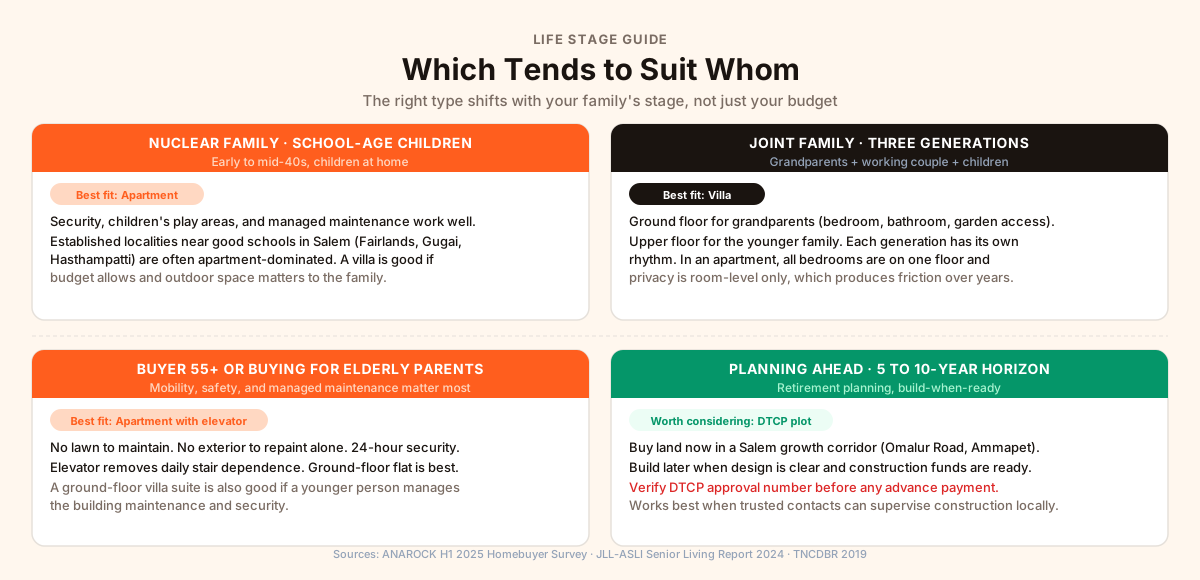
A nuclear family with school-age children benefits most from an apartment in a gated complex near good schools. The community is structured: children’s play areas, organised security, and neighbours who keep an eye on the building. The managed maintenance leaves working parents with one less thing to organise.
A three-generation joint family almost always finds a villa more workable over the long run. The generational zoning (ground floor for parents, upper floor for adult children) gives everyone genuine privacy while sharing a home. An apartment can accommodate a joint family, but the floor plan leaves no space for separation between generations, and daily friction builds over years in ways that a two-floor villa’s layout naturally absorbs.
A family at 55 or above, or one buying primarily for elderly parents, will usually find a managed apartment with a reliable elevator the most practical choice. The elevator removes daily stair dependence. Round-the-clock security means the elderly person is not alone managing visitors and strangers at the gate. Maintenance is pooled, so a 70-year-old is not responsible for the roof or the overhead tank or the exterior wall. A ground-floor flat is also a very good option for someone who cannot manage stairs at all. A ground-floor suite in a villa works too, as long as someone younger is managing the building. If the search has moved to a 55-plus campus rather than ordinary housing, what to look for in a senior living community is the visit checklist.
A family buying ahead of retirement with a five to ten-year horizon before they need the home: a DTCP-approved plot in a growing Salem corridor can make sense. Buy the land now, build later when the design is clearer and construction capital is in place. This works best when the family has trusted people who can supervise the construction locally and does not need the property to generate income during the holding period.
The Financing Difference
Most families in Salem use a home loan. The type of property makes a significant difference here.
A flat is the easiest to finance. Banks and housing finance companies lend up to 90 percent of the property value for flats priced up to Rs 30 lakh, up to 80 percent for flats priced between Rs 30 lakh and Rs 75 lakh, and 75 percent above Rs 75 lakh. Tax deductions apply from the year of possession: Section 80C (on principal repayment) and Section 24(b) (on interest paid, up to Rs 2 lakh per year).
A villa (built independent house) follows similar terms to an apartment as long as it is a completed structure.
A plot loan differs from a home loan in three ways:
- The Loan-to-Value (LTV) ratio is capped at 70 to 75 percent of the plot value. You need a larger down payment than you would for a flat.
- Section 80C (principal repayment deduction) and Section 24(b) (interest deduction, up to Rs 2 lakh per year) tax benefits are not available until you have built the house and completed construction. On a plot-only loan, you pay the EMI but receive no tax offset during that period. Pre-construction interest can be claimed in five equal instalments after construction is complete, but only under the old tax regime.
- Most lenders require construction to start within two to three years of taking the plot loan.
For buyers aged 55 or above, there is one more constraint. Banks calculate the loan tenure to end by the time you turn 65 to 70. A 60-year-old applying for a loan may be eligible for only a 5 to 8-year term, which pushes EMIs very high. Adding an adult child as a co-applicant (a joint borrower on the loan) usually changes this picture significantly, as the bank uses the younger applicant’s age to determine the loan tenure.
Putting It Together
Three properties, three lives they will give you. Here is the short version:
Apartment: Best for ready shelter, managed maintenance, and community. Choose this if an elderly parent will live alone there, if the family needs a home quickly, or if ease of management across years matters more than land ownership.
Villa: Best for joint families across generations, for families who want to expand in the future, and for buyers who want direct land ownership. Choose this if the budget fits, the location is right, and you are prepared to carry maintenance yourself and enjoy the control that comes with it.
Plot: Best for buyers who are not in a hurry, who want full design control, and who see the next decade as a window to build on their terms. Before anything else: confirm DTCP or local planning authority approval in writing before paying any advance. An unapproved layout cannot legally receive utilities and is subject to demolition.
None of these choices is a mistake if it fits how your family actually lives right now. The only real mistake is picking the one that sounds best in a brochure.
Chola Builders has been working with Salem families since 1994, across apartments, villas, and land projects. If your family is in the middle of this decision, call us or send a WhatsApp and we will talk through your specific situation with no obligation.
If you found this useful, these posts may help your thinking further:
- Choosing a home for a joint family: what actually matters goes deeper on the room-by-room decisions once you have settled on a larger flat or a villa.
- Carpet area vs built-up vs super built-up area explains the floor area numbers builders quote, so you can compare apartment options on a like-for-like basis.
- Vaastu basics for a Tamil Nadu home covers orientation and room placement in a practical way for Tamil Nadu families, whichever property type you choose.