Approved vs Unapproved Layout: The One-Minute Idea
A plot looks right. The price is good. The agent says it is panchayat-approved. Here is what that phrase really means, why it matters, and the one thing to verify before you pay a rupee.
Last verified against government sources on . We re-check this post whenever rules change.
In this guide, you'll learn
- In Tamil Nadu, all residential plot layouts must be approved by the Directorate of Town and Country Planning (DTCP) outside the Chennai Metropolitan Area, or by the Chennai Metropolitan Development Authority (CMDA) within it, under the Tamil Nadu Town and Country Planning Act, 1971.
- The approval certifies zoning, minimum road widths, open space reservation (OSR), and clearances from multiple government departments. It is not a rubber stamp; it is the result of scrutiny across several agencies.
- A layout described as panchayat-approved is not an approved layout in law. Under Rule 3 of the Tamil Nadu Panchayat Building Rules, 1997, a panchayat cannot approve a layout. Only DTCP or CMDA can. This phrase is widely used to describe unapproved layouts.
- Unapproved layouts carry concrete legal risks: electricity, water, and sewerage connections can be denied; major banks will not lend on them; the sub-registrar may refuse to register the sale deed; and demolition is possible under the Tamil Nadu Town and Country Planning Act, 1971.
- The Tamil Nadu regularisation scheme covers only plots where a registered sale deed was executed on or before 20 October 2016. Plots bought after that date cannot use this scheme.
- Before paying any advance, ask the seller for the Layout Permit number (LP number) and verify it at onlineppa.tn.gov.in. If the number returns no result, do not pay.
A plot comes up for sale in a neighbourhood you like. The price is noticeably lower than similar plots nearby. The agent says it is panchayat-approved. The location works. You want to pay an advance.
Before you do, spend a minute understanding what “approved” means in Tamil Nadu. That one word can mean a plot that is fully cleared, financeable by a bank, and ready to register, or it can mean one that cannot legally get a permanent electricity connection.
Who Does the Approving
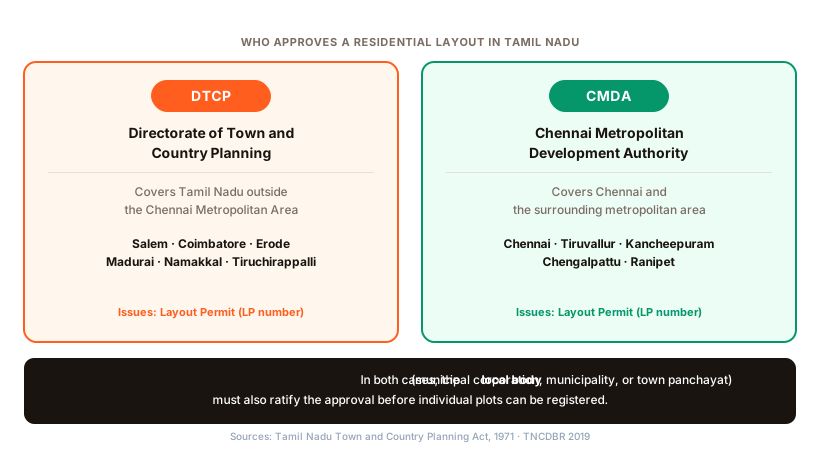
In Tamil Nadu, two bodies can approve a residential plot layout. Which one applies depends on location.
Outside the Chennai Metropolitan Area, the authority is the Directorate of Town and Country Planning (DTCP), a state government department with regional offices across Tamil Nadu. For Salem, Coimbatore, Erode, Namakkal, Madurai, Tiruchirappalli, and everywhere else outside Chennai’s extended metropolitan footprint, DTCP is the body to look for.
Within the Chennai Metropolitan Area, it is the Chennai Metropolitan Development Authority (CMDA), a body set up by state law to manage development in that region.
Both operate under the Tamil Nadu Town and Country Planning Act, 1971. Both follow the Tamil Nadu Combined Development and Building Rules, 2019. The approval they issue is called a Layout Permit, and it carries a unique LP number.
After DTCP or CMDA issues its technical clearance, the local body (municipal corporation, municipality, or town panchayat for that area) gives a second ratification. Only after both stages are complete can individual plots in the layout be legally registered and sold.
What the Approval Actually Certifies
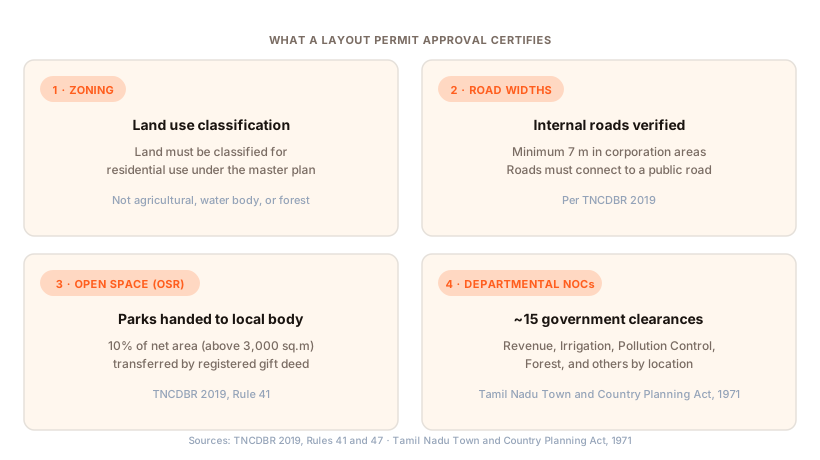
DTCP or CMDA approval is not a simple stamp. When a developer applies for a layout permit, the application passes through multiple government departments before it returns as an approved plan with an LP number. The clearance confirms four main things.
Zoning and land use. The land is classified for residential use under the applicable master plan, not agricultural, water body, coastal regulation zone, or forest land.
Road widths. The internal roads in the layout meet minimum standards. For layouts in Salem Municipal Corporation area, the applicable rules set a minimum of 7 metres for internal roads. Roads must also connect to a public road of at least the required width.
Open Space Reservation (OSR). For DTCP-jurisdiction layouts, any layout above 3,000 square metres (roughly 74 cents) must set aside 10 percent of its usable land area as public open space: parks and playgrounds that are physically handed to the local body by a registered gift deed (a legally executed deed that formally transfers ownership of that land to the local body) before the permit is granted. Once transferred, this land is irrevocably public and cannot be built upon, as confirmed by the Supreme Court in February 2023 (Association of Vasanth Apartments’ Owners v. V. Gopinath & Ors., 2023 LiveLaw (SC) 105).
Departmental clearances. Approvals from Revenue, Irrigation, the Tamil Nadu Pollution Control Board, Forest, and other departments, depending on the plot’s location and proximity to water bodies, highways, and sensitive zones.
The Two-Stage Reality
Most buyers who ask for a “DTCP-approved layout” do not realise there are two documents to ask for, not one.
The first is the Proceedings Order: the official government letter, signed by a DTCP official, that records the decision to approve the layout and carries the LP number. This is DTCP’s confirmation that the plan has been examined and approved.
The second is the local body’s ratification: the municipal corporation or town panchayat passes its own council resolution or commissioner order after the developer has physically handed over the roads and OSR land by registered gift deed and completed the required infrastructure. Only after this does the local body formally notify the Sub-Registrar’s office (the government office where property sale deeds are registered). That notification is the signal that plots in that layout can be registered.
A layout with only the first document is called provisionally approved, which means DTCP’s clearance is in hand but the local body has not yet given its ratification. Individual plot sales cannot be registered on a provisional approval alone. Both documents together confirm the layout is fully approved.
The “Panchayat-Approved” Trap
In Tamil Nadu, the phrase “panchayat-approved” appears widely in plot sale advertisements. It has no legal standing for layout approval.
Rule 3 of the Tamil Nadu Panchayat Building Rules, 1997 states clearly that no owner may subdivide land for building until the layout plan is approved by the panchayat’s Executive Authority with the prior concurrence of the Director of Town and Country Planning. A village or town panchayat executive has no authority to issue a Layout Permit on its own. Only DTCP (or CMDA within the Chennai Metropolitan Area) can do so.
What “panchayat-approved” typically means in practice: the layout has no DTCP clearance. The panchayat may have collected a local fee, or the developer may hold only a revenue conversion order (a government order that changes the land’s classification from agricultural to non-agricultural use). Neither is a Layout Permit.
What Happens in an Unapproved Layout
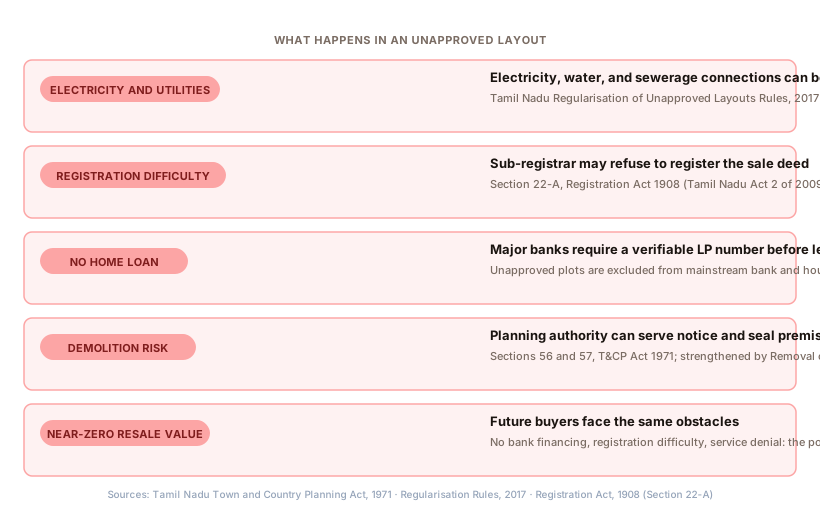
Electricity and utility connections denied. Buyers have found themselves living in a completed house with no permanent TANGEDCO (Tamil Nadu Generation and Distribution Corporation, the state electricity board) connection. Under the Tamil Nadu Regularisation of Unapproved Layouts and Plots Rules, 2017, building plan approvals, electricity connections, water supply, drainage, and sewerage connections can all be denied to plots in unapproved layouts that have not been regularised.
Registration difficulty. Tamil Nadu law empowers the sub-registrar (the government officer who registers property sale deeds) to refuse registration of a sale deed for plots in layouts without planning authority approval. This power, under Section 22-A of the Registration Act, 1908, became operative in October 2016 after a Madras High Court directive. It remains in force: the sub-registrar can still refuse to register a sale deed for a plot in an unapproved layout.
No home loan. Major banks and housing finance companies require a verifiable DTCP or CMDA LP number before sanctioning any plot loan. Without it, mainstream financing is unavailable.
Demolition risk. The planning authority can legally order the owner to demolish what has been built and restore the land to its prior state. Tamil Nadu planning law (Sections 56 and 57 of the Tamil Nadu Town and Country Planning Act, 1971) provides this power, and the Tamil Nadu Town and Country Planning (Removal of Unauthorised Development) Rules, 2022 strengthened enforcement. Madras High Court rulings, including a February 2025 decision, have confirmed that regularisation is not an automatic right.
Resale. A future buyer faces the same obstacles: no bank finance, registration difficulty, utility denial. The pool of buyers willing to take on an unapproved plot is very small, and they negotiate hard on the risk.
Can an Unapproved Layout Be Regularised?
Tamil Nadu does have a regularisation scheme for unapproved layouts, but the eligibility window has a hard cutoff. Only layouts where at least one plot was sold via a registered sale deed on or before 20 October 2016 are eligible. Plots purchased after that date cannot use this scheme, regardless of how many times the deadline is extended.
The scheme operates under Section 113-C of the Tamil Nadu Town and Country Planning Act, 1971, governed by the Tamil Nadu Regularisation of Unapproved Layouts and Plots Rules, 2017.
Certain land cannot be regularised at all: plots on water bodies, poramboke land (government-owned common land such as grazing grounds or village commons), existing OSR areas, plots blocking road access, and rail or road corridors.
As of Government Order (G.O.) No. 148 dated 27 July 2026, individual plot owners can apply without a fixed deadline; layout promoters and developers can apply until 30 June 2027. The scheme has been extended multiple times since 2017.
The Check Before Paying an Advance
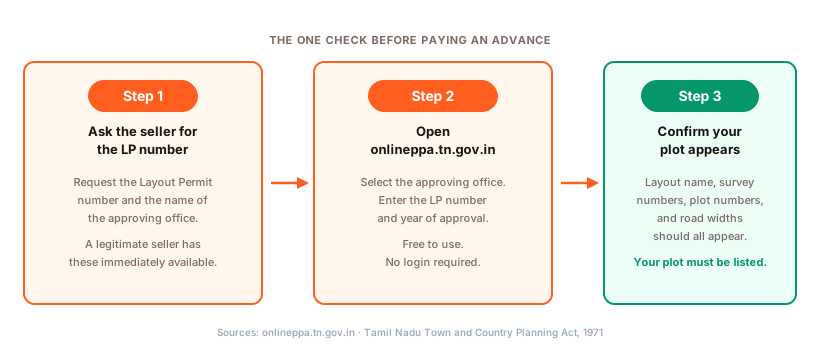
Ask the seller for two things: the LP number and the name of the approving office.
Then look it up at onlineppa.tn.gov.in, the Government of Tamil Nadu’s portal for planning permissions (PPA stands for Planning Permission Application). Select the approving office, enter the LP number and year of approval, and run the search.
A genuine approved layout will show the layout name, survey numbers (the reference codes the government uses to identify land parcels), plot numbers, approved road widths, and open space reservation details. Your specific plot number should appear in the approved plan.
Layout approvals from before approximately 2011-12 may not appear in the online database. For older approvals, the relevant DTCP regional office holds the records. Ask the seller for the original Proceedings Order and the registered gift deed numbers for the OSR and road handover.
What This Means for You
An approval is not optional. It is the legal floor for a residential plot in Tamil Nadu.
The price gap between an approved and an unapproved plot in the same area is real and often significant. That gap is the market’s estimate of the risk you take on. It is not a bargain. It is a discount for a reason.
Deciding between a plot, an apartment, or a villa? The guide to apartment, villa, or plot covers that comparison. For terms that come up in any property purchase, like patta and encumbrance certificate, the property documents guide has plain-language explanations. If you are also looking at flats, carpet area vs super built-up area explains the area terminology.
Chola Builders has been building in Salem since 1994. If you want to understand what documentation a particular plot carries, call us or send a WhatsApp message.