
Griha Pravesh: Choosing the Right Day to Move Into Your New Home
The day you cross your new threshold is one that most Tamil families carry in memory long after the move. This post explains what gruhapravesam is, why choosing an auspicious time matters to so many households, and how a priest and the panchangam help you find the right date.
Last verified against government sources on . We re-check this post whenever rules change.
In this guide, you'll learn
- Griha pravesh, called gruhapravesam in Tamil, is a Hindu housewarming ceremony with roots in classical ritual texts going back over a millennium.
- The ceremony typically includes a Vastu Homam (fire ritual to consecrate the space), a Ganapathi Puja, the paal kachal (milk boiling by the lady of the house), and formal threshold crossing with the right foot first.
- A muhurat is an auspicious time window selected from the Tamil panchangam using five factors: tithi (lunar day), vara (weekday), nakshatra (birth star), yoga, and karana.
- In Tamil tradition, the muhurat date is anchored primarily to the birth star of the lady of the household, called the Grahalakshmi. Your vadhyar will need the janma nakshatra and rasi of every family member who will reside in the new home.
- Several Tamil months are traditionally avoided for gruhapravesam, including Aadi, Margazhi, and Purattasi. Vaikasi, Karthigai, and Masi are among the preferred windows.
- Apartments follow the same ceremony as independent homes. The one practical adaptation: gho puja (cow worship at the entrance) is generally skipped when the flat is above the ground floor.
The day you cross the threshold of your new home is unlike any other. You have signed the documents, received the keys, and walked through the flat a dozen times during construction. But the moment of actual entry, the gruhapravesam, is something different. It is when a building becomes a home.
Most Tamil families do not just move in. They consult the family vadhyar (the priest who advises on both ritual and auspicious timing), pick the right date from the panchangam, invite relatives, and light the kitchen stove for the first time with deliberate care. This post explains what that tradition is, why it matters to so many households, and how to go about choosing the right day.
What Griha Pravesh Means
The word comes from two Sanskrit roots: griha (home) and pravesha (entry, going inside). Classical Sanskrit dictionaries define it as “a solemn entrance into a house according to prescribed rites.” In Tamil, the ceremony is called gruhapravesam, and both terms are used interchangeably in Tamil Nadu.
This is not a recent custom or a folk invention. The ritual sequence appears in the Manasara, a Sanskrit text on sacred architecture from around the 5th to 7th century CE (the exact date is debated by scholars), and in still older Grihyasutras, the Vedic domestic manuals that covered every major life event from birth to death. The ceremony has been part of Hindu household practice for well over a millennium.
Traditional practice recognises three situations:
New home, first entry (Apoorva): When a family enters a brand-new home for the very first time, built on land where no prior dwelling stood. This is the most complete form, calling for the full sequence of pujas and homams.
Resale or return (Sapoorva): When re-entering a home that already existed and was previously lived in, such as buying a resale flat or returning after a long period away.
After major renovation (Dwandwah): When re-entering after substantial repair or reconstruction following damage. A rite is performed to re-consecrate the space.
For most families buying a newly built flat in Salem, the occasion is Apoorva, and the ceremony is done in full.
What Happens on the Day
A full gruhapravesam typically runs two to four hours. The family vadhyar or sastrigal conducts it. In Tamil Nadu, the vadhyar often serves as both astrologer and ritual officiant: the same person who fixed the date now performs the rites.
The ceremony begins before the family enters. A kolam, the rice-flour geometric design, is drawn at the entrance by the women of the household. A garland of mango leaves is hung above the main door. These preparations are as old as the custom itself. The kolam is understood to invite Goddess Lakshmi in and to leave an offering of rice flour for the smaller creatures of the world; Sahapedia, an independent cultural resource partly supported by India’s Ministry of Culture, notes that the threshold kolam in Tamil tradition marks the meeting point of the internal and the external.
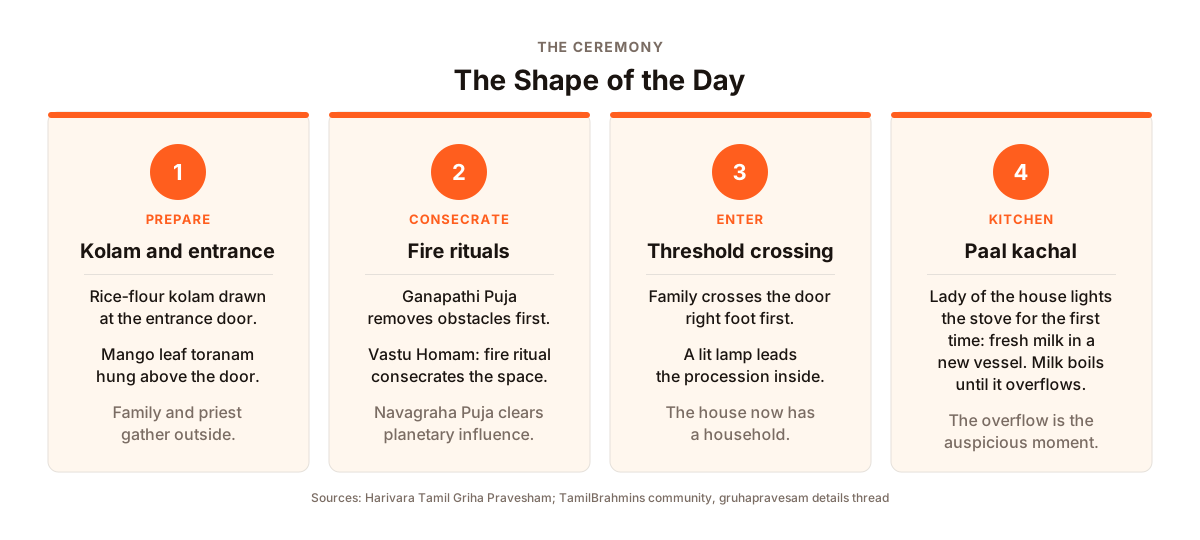
Inside, the ritual sequence moves through a Punyahavachanam (water purification of the space), a Ganapathi Puja (invoking Ganesha to remove obstacles), a Vastu Homam (the fire ritual at the centre of the home, propitiating the Vastu Purusha and aligning the five elements), and a Navagraha Puja (worshipping the nine celestial bodies to clear any adverse planetary influence on the household).
The moment that Tamil families in particular remember is the paal kachal. The lady of the household lights the kitchen stove for the first time using a new vessel, fills it with fresh cow’s milk, and watches until the milk rises and overflows. The overflow is intentional: some traditions describe it as evoking the cosmic ocean of milk from which Goddess Lakshmi emerged. The overflow represents abundance that cannot be contained. Families gather around the stove at this moment; the overflowed milk becomes the prasad shared with everyone present.
After the rituals, the family crosses the threshold formally, right foot first, carrying a lamp.
Some families and priests keep the ceremony compact. Others add a Lakshmi Kubera Homam or a Sudarshana Homam on top. The core, the Vastu Homam and the paal kachal, is what most Tamil families consider essential.
One detail worth knowing: the tradition holds that the family should sleep in the new home for at least three consecutive nights after the ceremony. The gruhapravesam is not considered complete with just the puja on the day. Moving in fully seals it.
Why an Auspicious Time Matters
A muhurat (from the Sanskrit muhurta, meaning a moment or time window) is selected from the panchangam by a priest or astrologer. The philosophical basis is this: in the Hindu understanding of the universe, time is not uniform. Different moments carry different qualities of energy, shaped by the positions of the sun, moon, and planets relative to a family’s own horoscope. Starting a significant chapter of life when those factors line up well is understood as giving the household a good start.
Whether one holds to that reasoning or not, the practical effect of choosing a muhurat is real. It creates a focal point: a specific, planned day around which relatives can gather and the ceremony can be done properly. Many families find that the process of consulting the priest, gathering the horoscopes, and receiving a shortlist of dates is itself part of the transition. The home becomes real in a different way once a date has been set.
The Five Threads of a Muhurat
The Tamil panchangam is an almanac, published annually, that combines astronomical observation with traditional ritual guidance. Its name comes from pancha (five) and anga (limb). The five elements it tracks are what the vadhyar consults when calculating your muhurat.
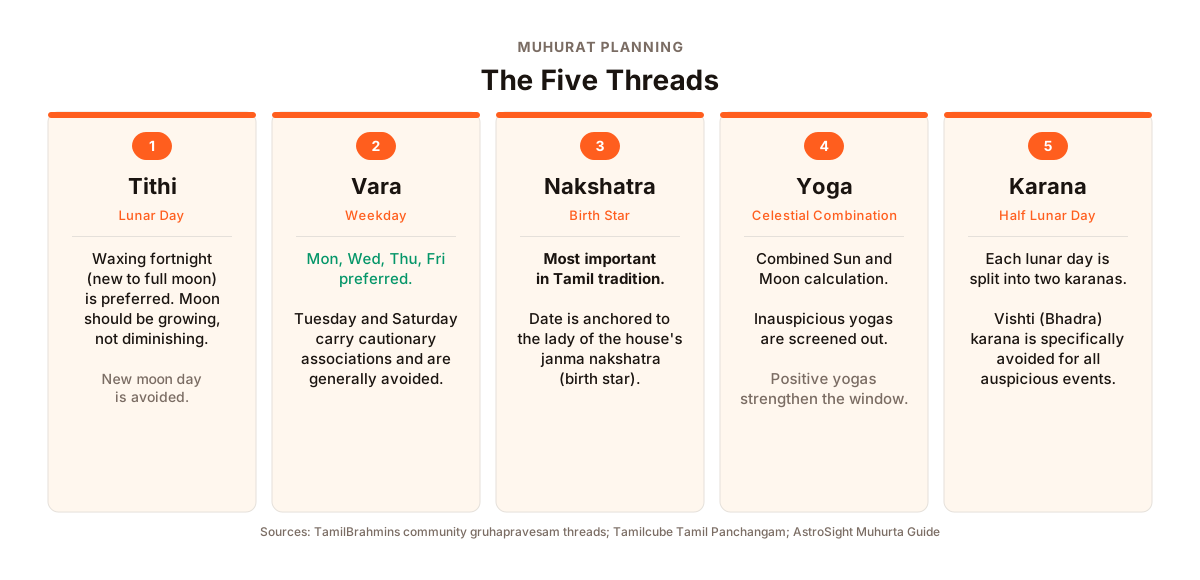
Beyond the five threads, the vadhyar also considers Rahu Kalam: the approximately 90-minute inauspicious window that shifts each day of the week. Tamil families observe this more strictly than most other communities in India. No ceremony should begin or end within the Rahu Kalam window. Your vadhyar will factor this in when narrowing a broad muhurat to the precise 1-2 hour ceremony window.
Two panchangam traditions coexist in Tamil Nadu. The Vakya system underlies the Pambu Panchangam, published since 1883 and printing around 300,000 copies annually. The Thirukanitha system uses modern computer-aided astronomical calculations. For broad muhurat purposes the dates generally agree; the precise timing within a day may differ slightly. Most vadhyars use the printed Pambu Panchangam as their working reference.
The Tamil Calendar: Months That Work
Not all months are equally suited for a housewarming in Tamil tradition. The twelve Tamil months divide roughly into preferred windows and months to pause on.
Sources: TamilBrahmins community, Tamil months suited for house warming; TamizhConnect, Aadi month guide
Preferred windows: Vaikasi (mid-May to mid-June), Avani (mid-August to mid-September), Karthigai (mid-November to mid-December), Masi (mid-February to mid-March), Chithirai (mid-April to mid-May), and Aippasi (mid-October to mid-November) are among the months families most often choose. In practice, the list varies somewhat by tradition and by vadhyar.
Months to pause on:
Aadi (mid-July to mid-August): Falls during Dakshinayana, the sun’s southward movement, which the Hindu calendar treats as the less auspicious half of the year. Aadi is also associated with intense ancestral observances in Tamil tradition. Weddings and housewarmings are generally paused.
Margazhi (mid-December to mid-January): A month of intense devotional focus, the season of the Tiruppavai and Tiruvembavai recitals. Celebrations are traditionally set aside.
Purattasi (mid-September to mid-October): A month of fasting and Vishnu worship, which also coincides with Mahalaya Paksha, the annual period of ancestral rites. Auspicious events are universally paused during Mahalaya Paksha.
Aani (mid-June to mid-July) is also traditionally avoided. Panguni (mid-March to mid-April) appears on the avoided list in many practitioners’ advice, though some families in certain communities do hold ceremonies in Panguni. Check with your vadhyar.
Beyond months, eclipse periods, the intercalary month (Adhik Maas, an extra month added to the Hindu lunar calendar roughly every three years to realign it with the solar year; traditionally considered inauspicious for new ventures), and periods when Jupiter or Venus comes too close to the sun and becomes invisible in the sky (called Guru Asta and Shukra Asta) are avoided regardless of which month they fall in. Your vadhyar will know the current Asta dates.
Talking to Your Vadhyar: What to Bring
In Tamil Nadu, the vadhyar or sastrigal typically serves as both astrologer and ritual officiant. You approach them once you have an approximate move-in window in mind. They cross-check the panchangam against your family horoscopes and give you a shortlist of suitable dates.
To fix the muhurat, your vadhyar will need the janma nakshatra and rasi (birth star and moon sign) of every family member who will live in the new home. In Tamil tradition, the date is anchored primarily to the birth star of the lady of the household, called the Grahalakshmi (the woman of the house in her role as the family’s bringer of prosperity). This is one of the distinctly South Indian emphases: the woman of the house is the pivotal figure in determining the right moment. The husband’s horoscope serves as secondary reference.
The vadhyar also checks the dasha (the planetary period each person is currently running through, as Hindu astrology assigns every life a sequence of planetary phases lasting several years each). And they screen for Chandrashtama: the days each month when the moon sits in the eighth sign from a person’s birth Moon sign, which is traditionally considered inauspicious for new beginnings. Taken together, they arrive at a 1-2 hour window on a specific day that satisfies all the criteria.
It is worth telling the vadhyar your practical constraints: which weekends work for relatives to travel, when your key family members are available. Priests can usually find a suitable date within real-world bounds, especially when given several weeks of lead time.
A Note on Apartments
A gruhapravesam in an apartment follows the same essential sequence as in an independent home. The Vastu Homam, Ganapathi Puja, Navagraha Puja, paal kachal, and threshold crossing all take place inside the flat itself.
The one common adaptation: the gho puja (cow worship at the entrance) is generally skipped when the flat is above the ground floor. A cow and calf cannot easily climb a staircase, and Tamil community practice has settled on this as a practical exception rather than a ritual failing.
The kolam goes at your own flat’s front door. The Vastu Homam is performed at the Brahmastana (the central zone of the home, kept open and uncluttered in Vastu tradition) of your unit. The ceremony treats the flat as your complete home, because it is.
Some families, when they can take possession but a good muhurat is still weeks away, do a simple paal kachal on any broadly auspicious day to mark their first entry, then perform the full gruhapravesam on the chosen date later. Most priests are comfortable with this two-step approach, and it is documented in Tamil community practice.
Putting It Together
The gruhapravesam pulls the first fire in the kitchen, the gathering of the people who matter most, and the deliberate choice of an auspicious day into one moment. It makes the threshold crossing a memory, not just a move. That is what the tradition has always done, and why so many families still make time for it.
If you are buying a home in Salem and want to talk through timing, floor plans, vaastu orientation, or anything else about the home itself, we have been building in this city since 1994. Call us or send a WhatsApp and we will make time for a conversation.
For more on related topics, you may find these useful:
- Vaastu Basics for a Tamil Nadu Home: directions, room placement, and what to ask your builder
- Choosing a Home for a Joint Family: rooms, shared spaces, and what elders actually need
- Apartment, Villa, or Plot: Which Is Right for You?: an honest comparison for Salem families at different life stages